Historical background and roots of tradition
Banari, known in Sardinian as Bànari (in the Middle Ages also attested as Vonari or Vanari), is a village in the Meilogu, in the province of Sassari. The etymology of the name is uncertain and probably of pre-Roman or Paleo-Sardinian origin: the main hypotheses link it to the Nuragic people of the Balari, or to the Phoenician root bana ("building, dwelling"), pointing to a very ancient settlement on this land.
The village stands on a basalt plateau in the heart of the Meilogu, a historic sub-region of northern Sardinia with a rich Nuragic and medieval heritage. In the Middle Ages Banari belonged to the Giudicato di Torres, in the curatoria of the Meilogu; after the fall of the giudicato it gradually came under Aragonese control. The territory preserves important historical evidence, including the church of Sant’Andrea Apostolo and numerous nuraghi in the surrounding landscape. The community has kept its cultural identity alive, expressed with particular care in its traditional dress — the bestimenta de muda — recognised by its refined polychrome silk embroidery, its red pleated skirt and its hand-embroidered white tulle veil.

Women’s dress
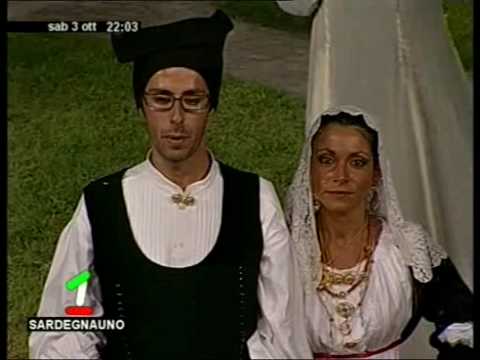
The bestimenta de muda is the festive dress of Banari. The velu (veil) is white tulle, square-shaped and hand-embroidered with floral motifs; it is worn resting on the head and covers the bust completely. The camija (shirt) is white cotton, with lace on the collar and embroidery on the chest.
The imbustu (bodice) is beige silk brocade, with polychrome floral embroidery on the back. Stiffened with iron stays at the front and rush strips in the rest of the bodice, it features a row of tabs at the bottom forming the peplum. It ends in two points tucked under the skirt and is fastened at the front with a crossed red ribbon. The corittu (short jacket) is amaranth red velvet, with polychrome floral embroidery in silk thread. It is a small shoulder-cover that leaves the bodice visible; without fastening, the sleeves have a small opening at the inner elbow letting the shirt show. The opening and cuffs are finished with an orange and black fur trim, the forearm is decorated with embroidered false buttonholes, and it is closed at the wrists by a silver filigree button.
The munnedda ’e sutta (underskirt) is white cotton, with two sangallo lace flounces. The munnedda (skirt) is red wool cloth, bordered with black velvet and fully pleated except for the front panel covered by the apron. On either side of the panel are two rows of blue velvet-covered buttons — one decorative and one for closing the skirt — and a black lace flounce enriched with a black cotton ribbon worked with floral motifs. The farda (apron) is black patterned silk, bordered with black lace and enriched with polychrome floral embroidery in silk thread; it is tied behind the back with a large embroidered bow.
Men’s dress
The men’s bestimenta de muda includes the berritta (cap), black wool cloth, tubular in shape with rounded edges about thirty centimetres long; it is worn falling forward. The bentone (shirt) is white cotton, with small pleats on the chest and a half-placket fastening; the fabric is narrowed at the cuffs with pleating and it is closed at the neck by two silver filigree buttons.
The coipette (waistcoat) is black velvet, with a central button fastening and one pocket on each side. The caltzones (trousers) are black wool cloth.
Main fabrics
Tulle, Cotton, Silk brocade, Velvet, Wool cloth, Silk, Lace
Occasion
Patron saint festivals, folk parades