Historical background and roots of tradition
Barisardo, known in Sardinian as Barì, is a village in the Ogliastra region, in the province of Nuoro, at the foot of the mountains descending towards the Tyrrhenian Sea. The original medieval toponym was Bary or Barì, of probable proto-Sardinian or pre-Roman origin, perhaps linked to a root indicating a low-lying or marshy area; in 1862, by Royal Decree no. 825 signed by Victor Emanuel II, the suffix “Sardo” was added to avoid post-unification confusion with the city of Bari in Puglia, even though the inhabitants continue to call it simply Barì. The territory, set between the National Park of the Gulf of Orosei and Gennargentu and the Ogliastra Riviera, combines a mountainous hinterland with a rocky coastline.
Women’s dress
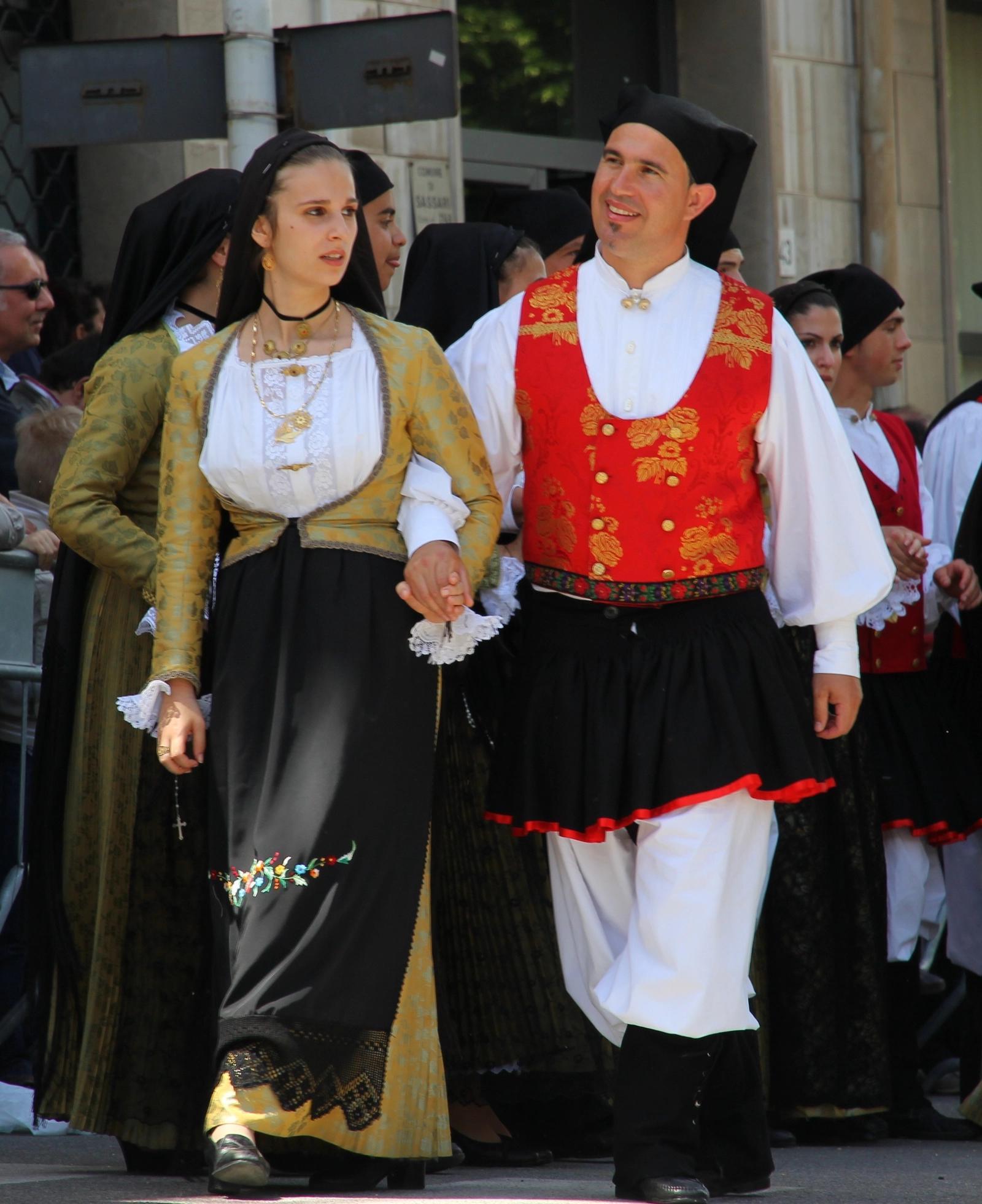
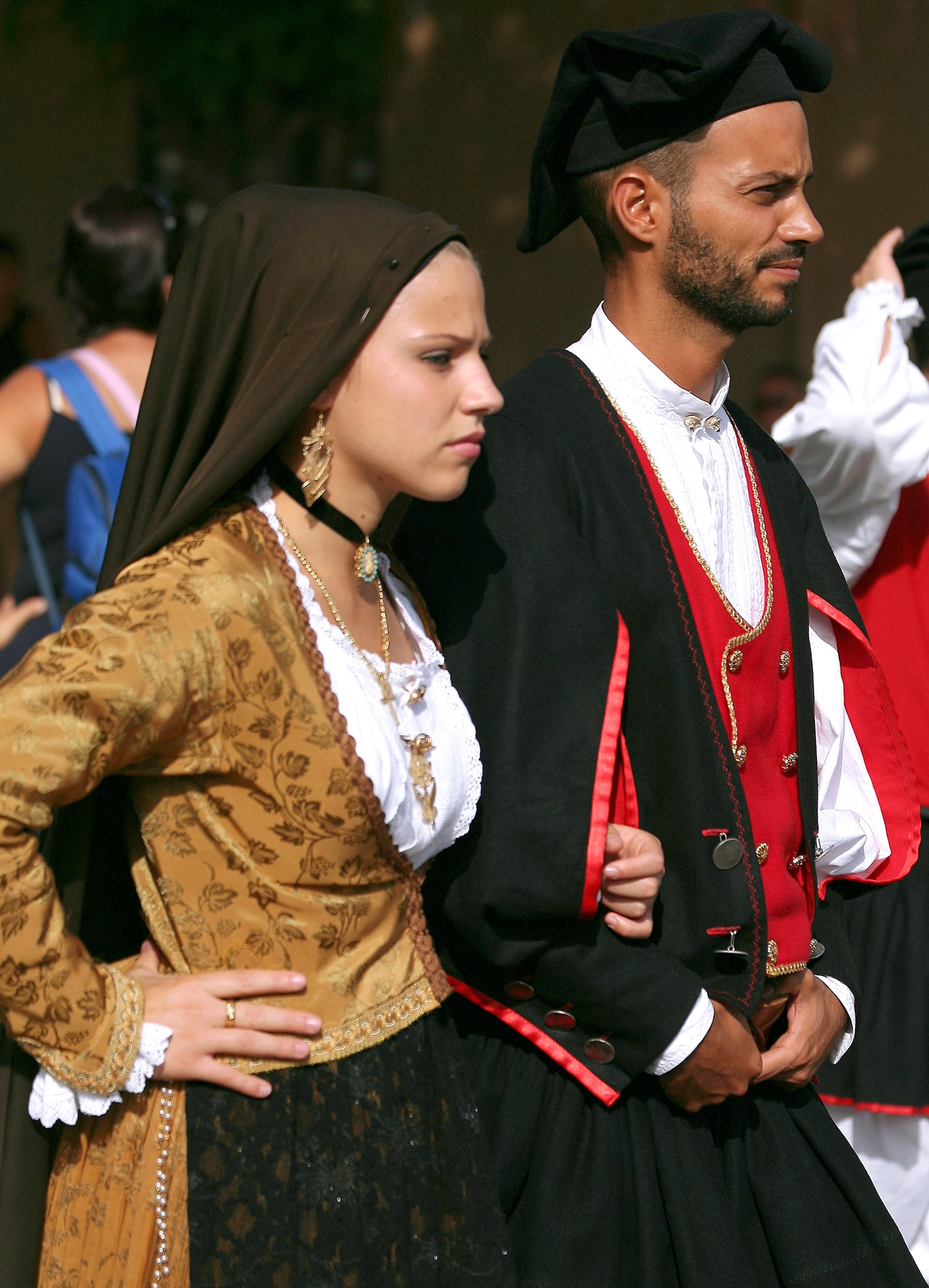
The bridal dress is the most elaborate version. On the head is worn the sciallu, a brown tibet shawl, square in shape with long silk macramé fringe sewn along the edges, folded into a triangle and fastened with an agulla, a gold filigree brooch. The camisa is a white cotton blouse with the chest entirely worked in filet lace — on which the jewels are pinned — and cuffs trimmed with filet or crochet embroidery and lace; to set off the embroidery, a pink knee-length wool undergarment is worn beneath. The gippone is a jacket in gold-yellow damask silk with vine-leaf or bunch-of-grapes motifs — known as purdoni de s’agina — very fitted, with a wide neckline, trimmed with pearl-grey passementerie and fastened at the waist with hooks; the flared sleeves with a small wrist slit reveal the embroidered cuffs of the blouse. Beneath is worn a white cotton underskirt with embroidery. The fardetta, the skirt, is in gold-yellow damask silk, fully pleated except for the front panel; the antaleni, the apron, is black lace, reaching to the hem of the skirt. The outfit is completed by the migias, white cotton stockings, and the scarpinus, black leather shoes.
The widow’s dress, in silk, was reserved for wealthier women. All elements are black — shawl, jacket, skirt and apron — except for the white blouse; gold filigree buttons complete the ensemble.
Men’s dress
The festive men’s dress. On the head is worn the berritta, a black wool-cloth cap of tubular shape with rounded edges, about sixty centimetres long, worn folded over on itself. The camisa is a white cotton shirt with floral embroidery on the collar and cuffs; at the collar, the buttonis — gold filigree buttons — fasten the garment. The corpettu is a waistcoat in red wool cloth with the back in black cloth, a wide neckline and a double-breasted fastening. The bragas are white linen breeches, fairly wide and reaching mid-calf, worn tucked into the gambalis, black wool-cloth gaiters that cover the calf, end in a rounded shape and are fastened at the side with crossed laces. Over these is worn the ragas, a black pleated wool-cloth kilt trimmed with a red ribbon; a narrow strip of fabric joins the front and back of the kilt passing under the crotch of the breeches. The sabattas are black leather shoes.