Historical background and roots of tradition
Bolotana, known in Sardinian as Golòthene (historically also Golòthana or Golòssene), is a village in the Marghine region in the province of Nuoro, situated on the north-eastern slopes of Monte Rasu at approximately 680 metres above sea level. The name has ancient origins, likely of pre-Roman derivation: the root gol- is thought to mean “valley”, describing the hilly terrain in which the village lies. In the Middle Ages the settlement was documented as Golothana (1388), Bolonthenis (1342) and Golotzene. The territory has been inhabited since the Nuragic Age, as evidenced by numerous remains in the area, and in the medieval period it was part of the Giudicato di Torres. Bolotana is noted in the Marghine for its lively craft tradition — particularly weaving and the production of orbace woollen goods — and for its rural churches, including the parish church of San Michele Arcangelo, the heart of the town’s liturgical celebrations and traditional festivals.

Women’s dress
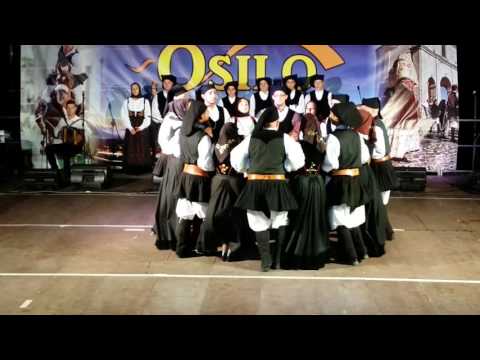
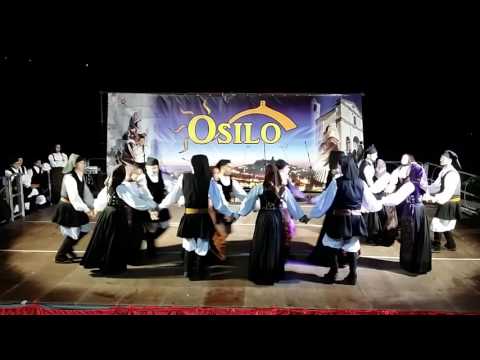
On the head is worn the muccadore, a square brown cotton headscarf with embroidery on the visible part at the back of the head. It is folded into a triangle and tied under the chin.
On the upper body, the camisa is a white cotton blouse, pleated at the chest, with lace applied to the chest, collar and cuffs. Over it is worn the imbustu, a black velvet bodice with polychrome floral embroidery, a rigid structure and a front lacing of crossed red ribbon.
The munnedda is the black skirt in tibet wool, with a wide black velvet flounce; at the back it features a very dense pleating called caramannòla. The farda is a black apron in damask satin with floral motifs.
Men’s dress
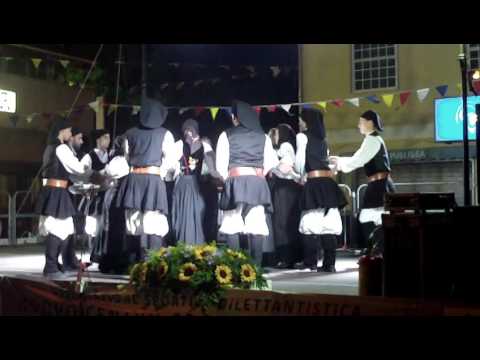
On the head is worn the berritta, a black woollen cap of tubular form with rounded edges, approximately sixty centimetres long. It is worn left to fall behind the head.
On the upper body, the camisa is a white cotton blouse, pleated at the chest. The corpette is a black velvet waistcoat with central buttons; on the left side there is a row of decorative buttons. The gabbanu is a black orbace wool jacket with a hood and a black velvet lapel that also lines part of the interior.
The cartzones are white cotton breeches reaching to mid-calf, worn tucked into the gaiters. The ragas is a black orbace wool pleated skirt, trimmed with black velvet, reaching to mid-thigh; a thin strip of fabric connects the front and back, passing under the crotch of the breeches. The mesas cartzas are black orbace wool gaiters trimmed with black velvet; they cover the calf, end rounded to conceal part of the shoes, and are fastened below the knee with a cord. The zinta is a brown leather belt.