Historical background and roots of tradition
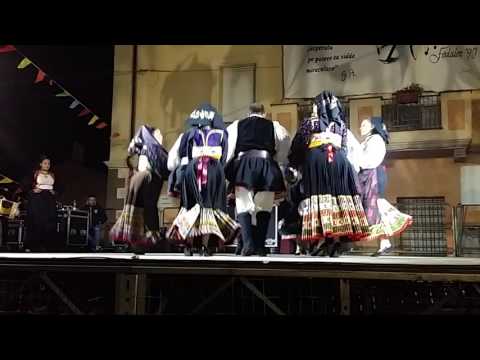
Budoni, known in Logudorese as Budùne and in Gallurese as Budòni, is a village in the Gallura region, in north-east Sardinia, situated on the north-eastern coast of Sardinia. The origin of the place name is not entirely clear: local hypotheses and studies of toponymy link it to a medieval root connected to ancient settlements or rural estates, but no certain or universally accepted etymology exists among historians. The territory extends between the Tyrrhenian shoreline and the first inland hills of the Gallurese hinterland, with a coast of sandy beaches and crystal-clear waters that has fuelled intense tourist development since the 1960s. Despite this recent growth, the community has kept its traditions alive: the festive dress — passed down through local cultural associations — remains one of the most recognisable symbols of Budoni’s identity at festivals, processions and folk events.
Women’s dress
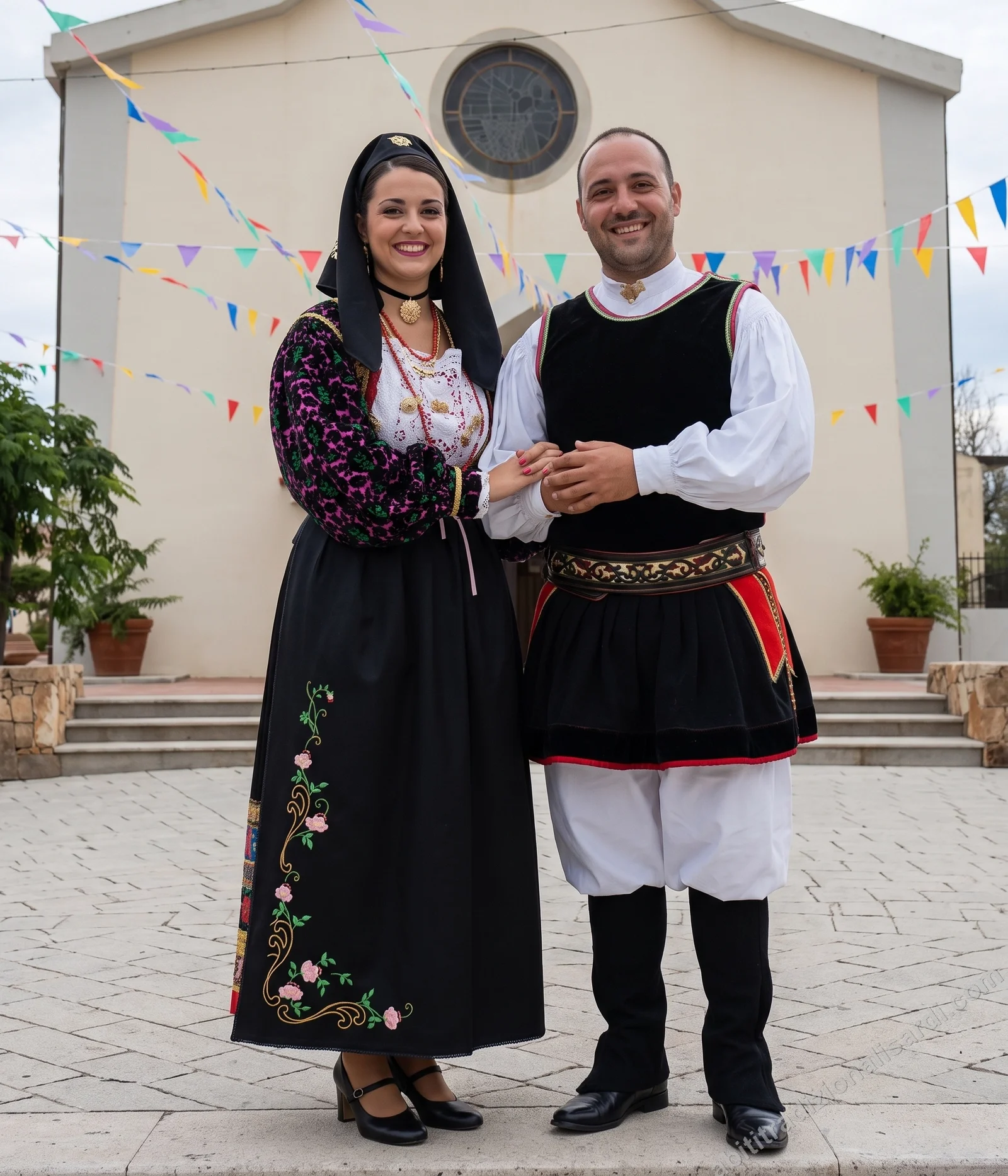
The women’s dress of Budoni is the bridal dress, distinguished by a rich layering of garments. The head is covered by the muccadore, a square black cloth headscarf with hand-embroidered multicoloured floral motifs on the visible part at the back; it is worn folded into a triangle, pinned to the hair and with the ends left loose.
The camisa is a white cotton shirt with embroidered intaglio work on the chest and cuffs; the fabric is gathered at the wrists in a pleated stitch called s’alchittu. Traditionally, a piece of pink cloth was worn beneath the shirt to bring out the embroidery. Three bodices are layered on the torso: the cassu grogu, an orange cloth bodice edged with a wide pink cotton band worked with floral motifs in silk thread, reaching to the hips and without fastenings; the corittu, a small bordeaux velvet bodice edged with a white cotton band with multicoloured floral motifs, enriched at the back with gold passementerie, coloured floral embroidery and gold paillettes, worn over the orange bodice and fastened below the bust with a pink ribbon; and the zippone, a jacket in patterned velvet with floral motifs on a purple ground with black and green details, entirely edged with a red floral cotton band and trimmed with gold passementerie, with very wide sleeves.
The unnedda is a black cloth skirt, fully pleated except for the front panel; it is edged with red satin ribbon and has several tiers of multicoloured patterned cotton bands with floral motifs, finished with gold passementerie. Two side openings in the front panel are trimmed with the same bands. The farda, a blue silk apron, completes the dress with floral embroidery at the waist and along the hem.
Men’s dress
The men’s festive dress, known as estire ‘e sa festa, is distinguished by the berritta, a black cloth tubular cap with rounded edges approximately sixty centimetres long, worn folded back on itself. The camisa, a white cotton shirt, has cuffs, collar and armhole gathered with a pleated stitch, s’alchittu, decorated with embroidery, and is fastened at the neck and cuffs with silver buttons. The cassu is a black velvet bodice edged with red satin ribbon and finished with hand-sewn coloured stitching.
The white cotton trousers, caltzone ‘e tela, reach mid-calf and are tucked into the gaiters. Over these is worn the caltzone ‘e pannu, a black orbace overskirt edged with a black velvet band and lined in red cloth, reaching mid-thigh, with two side pockets in red cloth; a narrow strip of fabric, sa latranga, connects the front and back panels by passing beneath the crotch of the trousers. The cartzittas are black orbace gaiters with a turned-down top, covering the calf and ending in a rounded shape that conceals part of the shoes, fastened below the knee with a lace. The tzinta, a black leather belt, is decorated with red satin applications and carved ornaments.
Main fabrics
Cloth, Patterned velvet, Cotton, Silk, Orbace
Occasion
Bridal (women) and festive (men)
Events in Budoni
-
28–30 August
Festa Manna di Budoni Go →