Historical background and roots of tradition
Olzai, known in Sardinian as Ortzài or Orthài, is a village of the Barbagia di Ollolai, in the province of Nuoro. The village stands at about 700 metres above sea level in the mountainous heart of the Nuorese, surrounded by holm oak and native oak forests. The etymology of the name is uncertain and is rooted in the Proto-Sardinian linguistic layer: the most debated hypotheses link it to the Phoenician word Hol or Hoel (“abode of the pilgrim”), to the name of the ancient Iolai — the indigenous tribe of Sardinia mentioned by the Greeks — or to the Sumerian root Ul-Za-I (“land rich in fruit”). The village’s modern history is marked by the figure of painter Mario Delitala (1887–1990), one of the most significant voices of twentieth-century Sardinian art, who was born in Olzai. The stone old town, typical of the Barbagia, preserves the church of San Giovanni Battista and a vibrant tradition of Barbagia di Ollolai dress. Olzai is also home to the Maimones, ancestral figures linked to the winter rites of the village.

Women’s dress
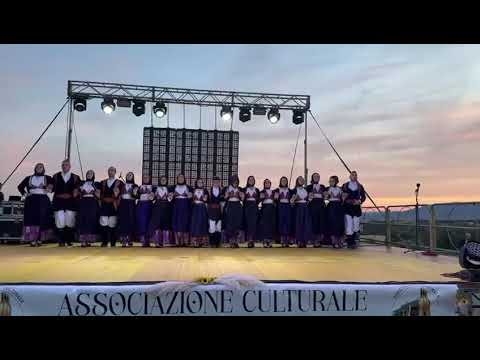
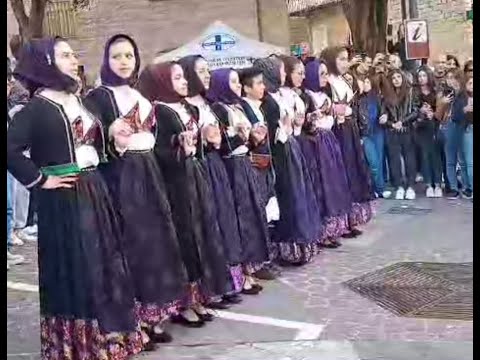
The traditional women’s dress of Olzai, in its bridal version, stands out for the vibrancy of its colours and the richness of its fabrics. On the head is worn the muccadore, a square scarf in figured silk, folded into a triangle and tied under the chin.
S’amisa, the white cotton shirt, is simply cut and reaches the ankle; the fabric is gathered at the wrists and neckline with pleating enriched by a coros embroidery.
S’imbustu, the green broccato bodice, is edged with yellow and orange cotton passementerie in floral patterns; it is made up of three sections joined by a fixed lacing at the back and ends at the front with two padded points edged in red cloth, fastened with small hooks under the bust.
Su zippone, the black panno jacket, is edged with a pleated green satin ribbon and enriched with brown passementerie.
Sa gunnedda, the black panno skirt, is fully pleated except for the front panel covered by the apron, and features a border of violet floral polychrome broccatello at the hem.
S’antalera, the black apron in figured satin with violet floral motifs, covers the front panel of the skirt.
Men’s dress
On the head is worn sa berritta, the black tubular panno cap with rounded edges, about sixty centimetres long, worn by folding the end back over itself. The white cotton shirt is embroidered on the chest.
Su cropette, the black panno waistcoat, fastens with a central row of buttons. Sos cartzones, the white cotton breeches, reach mid-calf and are tucked into black stockings; these cover the calf, end rounded to conceal part of the shoes, and are secured with a lace below the knee.
Sas cartzas, the black pleated panno short skirt, reaches mid-thigh and features a narrow strip of fabric joining the front and back panels under the crotch of the breeches. The waistcoat, peddes, is in brown leather. The belt, sa chintorza, is in brown leather with carved decorations.