Historical background and roots of tradition
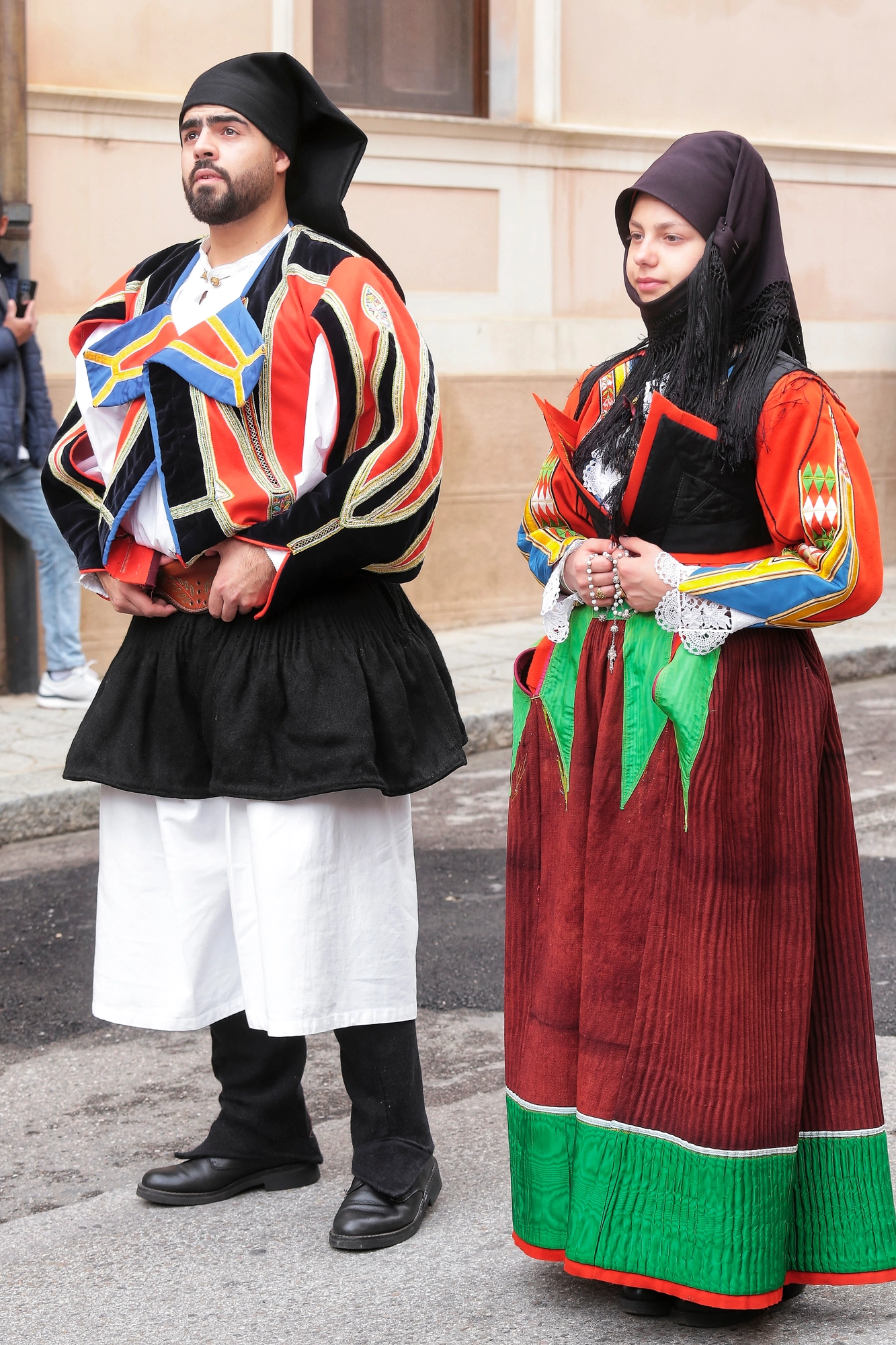
Orgosolo, known in Sardinian as Orgòsolo, stands on the slopes of the Supramonte in the heart of the Barbagia di Ollolai, province of Nuoro. World-famous for the protest murals that animate its walls, the village preserves a traditional costume of extraordinary complexity: three female variants determined by the woman’s civil status, and a men’s dress of unmistakable character — both living expressions of Barbaricinian identity.

Women’s dress
Su vistire de isposa (bridal dress) is the most elaborate variant. The hairstyle is built around sa caretta, a green brocade hairnet woven with silk, gold and silver threads, over which su lionzu is wrapped — a band of raw silk in ochre yellow cold-dyed with saffron, forming sa chintura of the headdress. The shirt, sa camisa, is of fine white cotton featuring sa collana, a needle-worked embroidery on the collar; it fastens with sos buttones (gold filigree cufflinks), su fermalliu (a gold brooch set with aquamarine) and sos ventallos (drop earrings). Over it is worn su zippone, a jacket of red cloth edged with blue satin and embroidered in silk — the so-called zippones cun sas puntas fioridas. The bodice, sas palas, is of grey raw cloth lined with black silk satin, bordered with red cloth and black brocaded velvet, completed by sa perla, a fustian panel with a yellow ribbon. The skirts are three: su saittu ruviu (brown orbace with a red border) and su saittu virde (brown orbace with a green border) are the pleated under-skirts; sa beste is the outer skirt of dark blue cloth with a green border. Completing the dress is s’antalena, the black silk apron embroidered in three sections: su telu in green and red brocade, sos lizos (stylised lilies and lotus motifs) and a geometric sa collana border.

Su vistire de vahanza (unmarried women’s dress) is simpler: a green brocade cap, a brown tibetan-wool shawl, a plain white cotton shirt, a red cloth jacket, a grey bodice lined with black satin and bordered with red cloth, and a brown orbace skirt with a green border.
Su vistire de viuda (widow’s dress) follows the structure of the bridal dress but with every element rendered in black: a single skirt of black orbace with a black velvet border, no jewellery, s’antalena reduced to three plain bands of black satin without embroidery, and the shirt without lace.
Men’s dress
Su vistire de vahanzu (young bachelor’s dress) is dominated by su zippone, a jacket of red cloth with blue velvet inserts — sas pinnas — and a squared neckline of blue satin embroidered in yellow. Sa berritta is the tubular black cloth cap of approximately 90 cm, an emblem of Barbaricinian tradition. The shirt, sa camisa, is of white cotton with embroidered collar and cuffs, fastened with gold and garnet buttons. Sos cartzones, white cotton trousers reaching to mid-calf, are worn outside the gaiters. Sa vraha is the short pleated black orbace skirt with velvet inserts; s’arthas are black orbace gaiters with leather straps; sas isharpas are black leather ankle-boots. The belt, sa vrentera, is of brown leather with red and green brocade inserts and side pockets.
Jewellery & Accessories
The women’s jewellery of Orgosolo is rooted in the artisanal tradition of gold filigree work. Sos buttones are cufflinks of gold filigree sheet; su fermalliu is an oval gold brooch set with a central aquamarine, of the same period. Among the rings: aneddu ‘e puntas, gold set with turquoises arranged in six points; aneddu cara ‘e coraddu, gold set with coral; and a third gold ring set with carnelian. Sos ventallos (drop earrings) and su oro (a gold link necklace) complete the bridal jewellery.


