Historical background and roots of tradition
Ploaghe, known in Sardinian as Piaghe (in Sassarese Piubagga), is a village in the historical region of Figulina (o Coros), in the province of Sassari, situated at 427 m above sea level. The town was an episcopal see from the eleventh century until the early sixteenth, when the diocese was merged into the archdiocese of Sassari; the parish house holds one of the most important painting collections in Sardinia, assembled in the nineteenth century by canon Giovanni Spano with works ranging from the fourteenth to the nineteenth century. The place name Piaghe is of uncertain origin: the main hypothesis derives it from a Greco-Byzantine root linked to a landholding or personal name (paulákes); minority theories propose Phoenician roots (Palegh, referring to the volcanic soil) or Roman origins (from a hypothetical founder named Publius).

Women’s dress
The women’s costume of Ploaghe is divided into three main variants, distinguished by occasion and social standing.
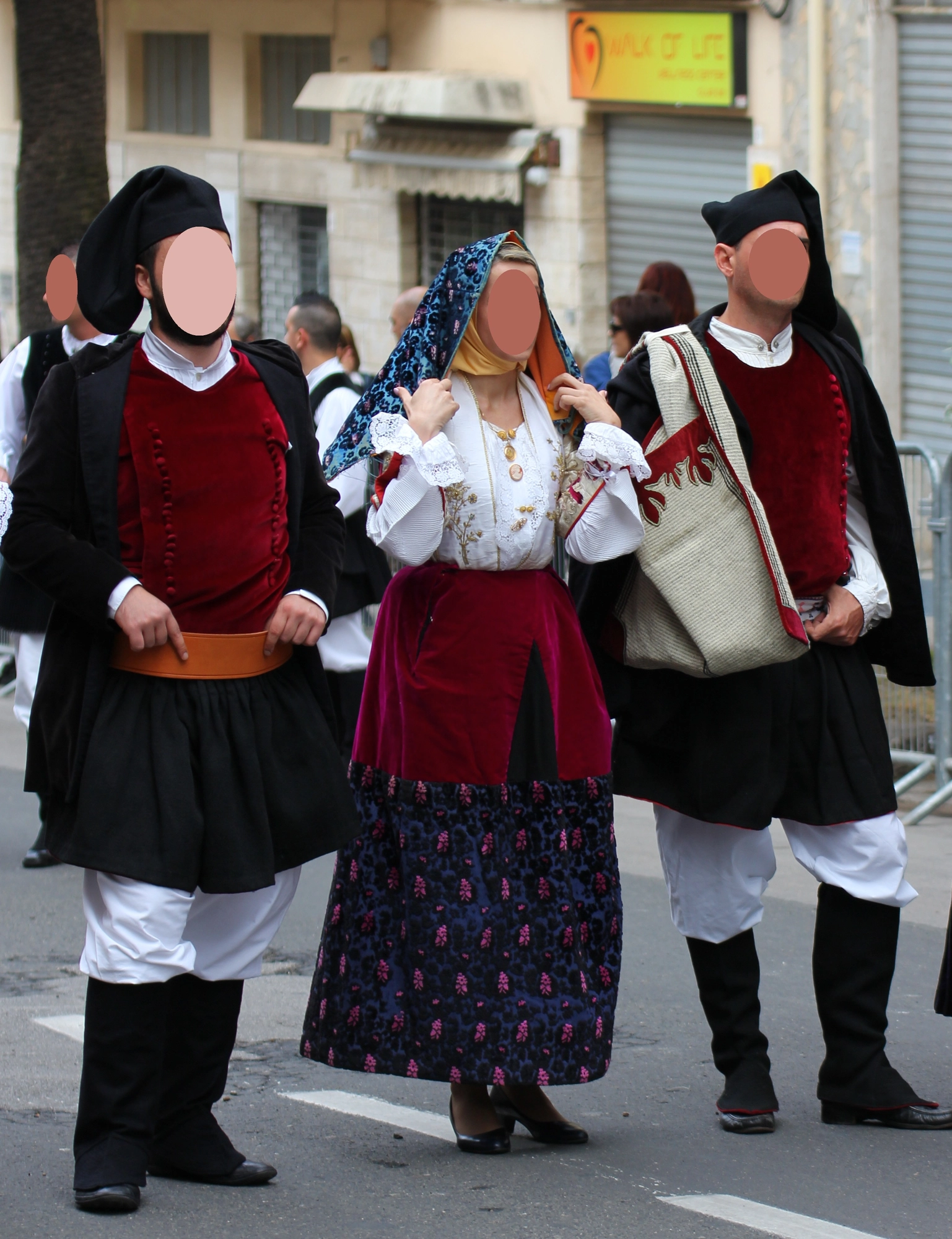
Sa este de velludu, the formal bridal dress, is the most elaborate. On the head one first wears the muncaloru de conca, the yellow woollen headscarf in square form, folded into a triangle, which wraps the head with its ends tucked in at ear level. Above it sits the manteddu, the square mantle in ochre yellow cloth covered with violet and black floral-pattern velvet on a blue ground, sewn so as to form a central cross of yellow fabric; it is worn resting on the head with the free ends falling over the shoulders.
The bodice consists of multiple layers. The camija, the white cotton shirt, has a collar embroidered in red and blue thread, an embroidered front panel, and lace- trimmed cuffs; the sleeve features s’affozzittadura, the dense pleating that spills out from the jacket. The corittu, the violet velvet jacket, has sleeves lined with silver cloth enriched by gold and silver bullion embroidery, with a longitudinal opening from elbow to wrist through which the shirt emerges; the cuffs are fastened with two gold filigree buttons secured by a ribbon. Beneath it is worn l’imbustu, the white corset in silver cloth entirely embroidered with gold thread, bullion work, and pearl applications, stiffened with ribs of dwarf palm or wild olive wood; at the back, a central hook holds sa rotula in place. Completing the bodice is the muncaloru de pettorras, the white silk chest-covering scarf, hand-embroidered with floral motifs in gold and silver thread and edged with gold braid.
The tuniga, the black cloth skirt, is fully pleated except for the front panel, partly covered with violet velvet (sas masculas), and adorned with a wide blue border of black-and-fuchsia floral velvet on a blue ground, called su frunimentu. At the back, dense folds form sa groppera, the characteristic rigid projection, supported by sa rotula, a rounded rag pad tied at the hips with cotton strings and hooked to the corset via sos ganzos.
Sa este de iscrallatta, the bridal dress worn by less wealthy families, follows the same structure as sa este de velludu: the jacket and skirt lining are made in red cloth rather than violet velvet, the jacket sleeve is in white brocade, and the corset is in violet velvet.
Sa este de batia, the widow’s dress documented from the late nineteenth century, is a rigorously dark ensemble: the muncaloru de conca in black wool, the black cotton mantle bearing a cross of ochre yellow cloth, the white cotton camija, the black satin corittu with red cloth inserts, the black velvet imbustu, the black satin chest-covering scarf, and the black orbace tuniga with a satin border.

Men’s dress
The men’s dress, worn for both everyday and festive occasions, comprises: the black cloth cap (berretta); the white cotton shirt; the sleeveless bordeaux velvet waistcoat (corpetto); the ragas, white cotton trousers; the short black orbace skirt bordered with red cloth; black orbace gaiters; and the chintorza, the black leather belt.
Jewellery & Accessories
Goldsmith work finds expression in the gold filigree buttons that fasten the cuffs of the corittu and in the gold and silver bullion embroidery enriching the jacket sleeves and the corset. The muncaloru de pettorras is distinguished by the gold braid edging its border, adding richness to the centre of the bodice. Of great symbolic significance is sa rotula, the hand-crafted pad that, tied at the hips and hooked to the corset through sos ganzos, gives the este de velludu its characteristic architectural silhouette.