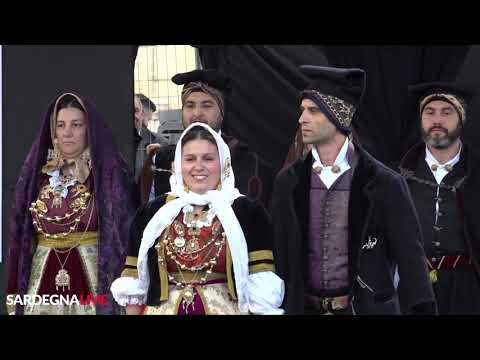
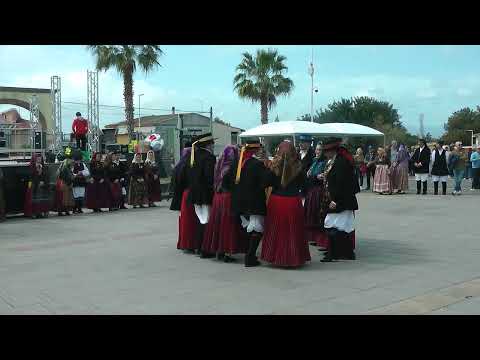
Historical background and roots of tradition
Quartu Sant’Elena, known in Sardinian as Cuartu Sant’Alèni (or Quattu Sant’Alèni), is one of Sardinia’s most populous municipalities, located in the Campidano di Cagliari overlooking the Gulf of Angels. The name “Quartu” refers to the town’s ancient position at the fourth mile of the Roman road from Cagliari; the addition “Sant’Elena” was appended only in 1826 to honour the city’s patron saint.
Women’s dress
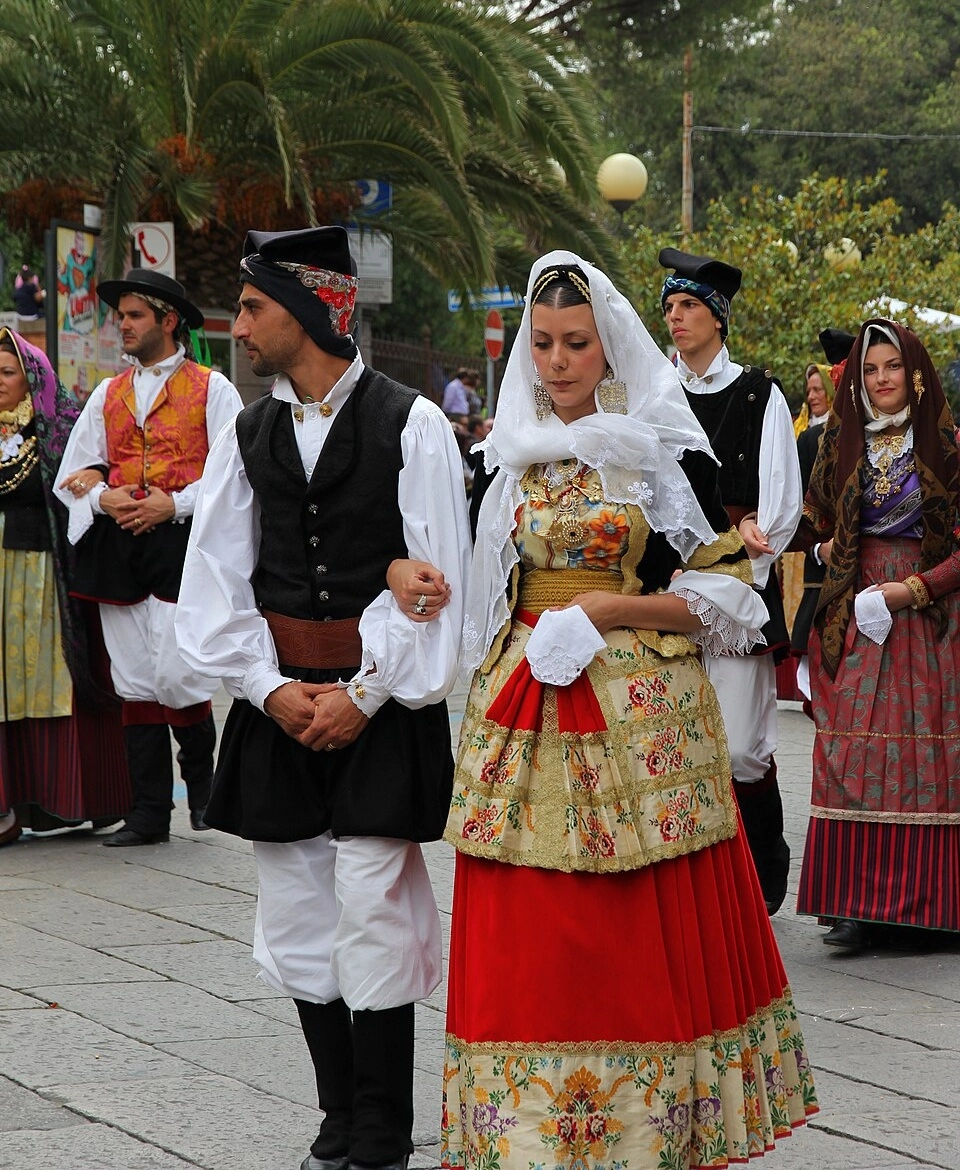
The women’s dress is the pannus arrubius (“red cloth” in Campidanese), a formal gala dress in red velvet from the late nineteenth to early twentieth century, accompanied by jewellery dating from the mid-1800s. The headdress consists of two superimposed elements: the cuffia, a black silk bag-shaped cap that gathers the hair and is fastened with a ribbon tied at the back of the neck, over which sits su froccu, a black velvet ribbon embroidered with gold cannetille and edged on the short sides with gold fringe; and the velo, a white square cotton tulle veil embroidered with floral motifs, folded into a triangle and pinned to the cap with a daisy-shaped brooch, agulla ’e conca.
The camisa is white cotton, lightly gathered across the chest, with embroidery on the shoulders (sa sprighitta) and lace applied at the collar and cuffs; rather low-cut, it reaches mid-calf and is made in two sections, the lower acting as a petticoat in less refined cotton cloth. The cossu (bodice) is white polychrome floral brocade trimmed with a magenta silk ribbon and enriched with gold passementerie; the lower section is in coarse cotton and is tucked inside the skirt; it is fastened at the front with three ribbons tied into bows. The muncadori de pittura (chest kerchief) is gold-yellow in worked silk with golden floral motifs, folded into a triangle with the ends crossed over the chest and pinned to the bodice. The velada (short jacket) is black velvet, shaped and edged with a gold galloon, with a three-quarter sleeve ending in a turn-back cuff, assiguredda, and no fastening. The manighittas (sleevelets) are magenta silk, lined in light-blue cotton, with cuffs edged in green polychrome floral brocade and a small opening that lets the lace of the camisa show through.
The gunnedda (skirt) is wine-red smooth velvet, fully pleated except for the front panel covered by the apron, with a flounce in white polychrome floral brocade edged with gold cannetille. The deventali (apron) is wine-red velvet faced with white polychrome floral brocade and edged with gold passementerie, trapezoidal in shape with central pleats, reaching above the knee. The tasca (busciacca, pocket) is green silk taffeta, embroidered with polychrome floral motifs in silk thread and gold cannetille, edged with a magenta ribbon and cannetille; it is worn over the skirt and under the apron. The mutandones are white cotton with a lower lace border. The crapittas (shoes) are black leather décolleté-style pumps faced in white brocade, worn with white knee-length cotton migias (stockings).
Men’s dress
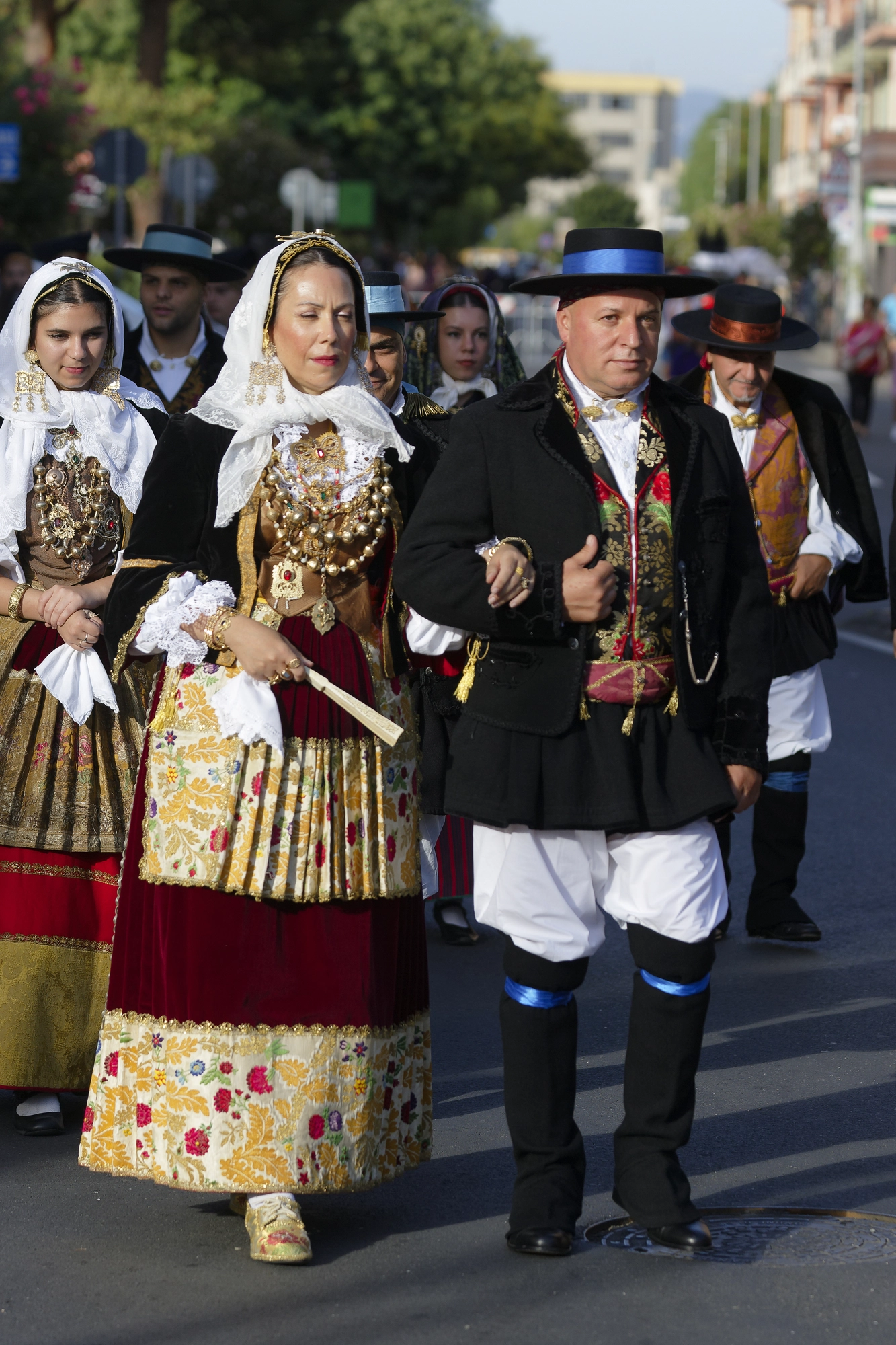
The men’s festive dress includes the berritta, a black cloth cap, tubular with rounded edges, approximately sixty centimetres long, worn folded back on itself. The camisa is white cotton with a high collar embroidered with floral motifs on the chest, armhole and cuffs; the collar is fastened with two gold laminate and filigree buttons. The cropettu (waistcoat) is floral-patterned velvet on a brown ground, with the back in brown cotton, a high collar, brown satin edging and a central row of silver filigree buttons. The sereniccu (short cloak) is black orbace with bordeaux velvet inserts, finished with black passementerie and fastened at the front with a silver chain, gancera.
The mudandonis (breeches) are white cotton, mid-calf length, worn tucked into the gaiters. The arroda (short skirt) is black cloth, pleated and reaching mid-thigh, with a narrow fabric strip joining the front and back panels passing under the crotch. The cratzas (gaiters) are black cloth with an upper turn-back and velvet edging at the bottom, covering the calf and ending in a rounded hem, fastened with a lace below the knee. The carrighera (belt) is brown leather faced with green velvet and a central brocade insert.
Jewellery & Accessories
The women’s jewellery, dating from the mid-1800s, attests to the outstanding goldsmithing tradition of the area. The lazzada (sash) is gold damask, formed by joining two ribbons and lined with gold-coloured cotton, approximately three metres long, wound around the waist as a belt. The muncadoreddu is a white silk handkerchief embroidered with polychrome floral motifs. The lasu (pendant) is gold laminate and filigree set with baroque pearls, semi-precious stones and a cameo, composed of three sections: su froccu (the upper part), su dominu (the central part) and su cammeo (the lower part); it is worn at the neck on a black velvet ribbon. The arreccadas (earrings) are gold laminate and filigree set with baroque pearls and semi-precious stones. The cannacca a pibionis (necklace) is gold laminate and garnets. A gold chain, giunchigliu, and gold rings complete the set.
Main fabrics
Velvet, Brocade, Silk, Cotton, Cloth, Orbace, Taffeta
Occasion
Religious festivals, folk parades
Events in Quartu Sant’Elena
-
7–20 September
Sant'Elena Imperatrice View →