Historical background and roots of tradition
Sestu, known in Sardinian as Sèstu, is a village in the Campidano di Cagliari, in the metropolitan area of Cagliari. The name derives from the Latin expression ad sextum lapidem: the settlement was established in Roman times at the sixth milestone, approximately six Roman miles from Karalis (Cagliari), along the ancient road Karalis-Turris.

Women’s dress
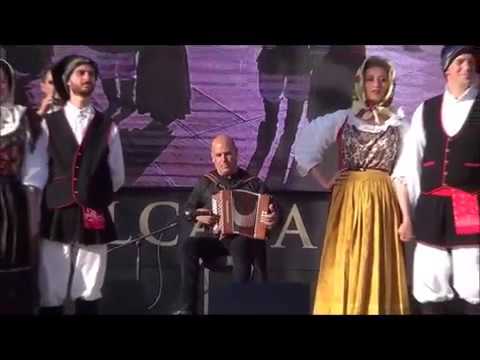
The traditional women’s wardrobe of Sestu includes two main variants. The festive peasant dress features a red cotton scoffia (cap), a brown printed cotton scarf rolled over the forehead, and a white and a brown scarf in patterned silk. The camisa is white cotton with lace on the neckline and cuffs and pleated sleeves with sonette gathers; the cossu is a green brocatelle corselet. A white silk chest scarf completes the bodice. The gunnedda is red and blue striped cotton; the davantali is black patterned silk.
The everyday festive dress is distinguished by a more elaborate headdress. The scoffia (cap) is black cotton, bag-shaped, gathers the hair and is tied behind the nape; a scarf is rolled over it to pin the other headpieces. The velu (veil) is white cotton tulle, square, embroidered with floral motifs, worn folded into a triangle with the ends loose. The muccadori (scarf) is rust-coloured patterned silk with floral motifs, also square, worn folded into a triangle with the ends loose.
At the bodice, the camisa (shirt), white cotton, has lace applied to the collar. The spenzu (short jacket) is brown silk, pleated at the front and shaped; it is edged with a bordeaux silk ribbon and fastened at the front with hooks. The muccadori ‘e pitturra (chest scarf) is rust-coloured silk, square, embroidered with floral motifs; it is worn folded into a triangle and pinned to the chest with a brooch.
The gunnedda (skirt) is red and blue striped cotton, fully pleated except for the front panel covered by the apron. The davantali (apron) is brown printed cotton, pleated at the waist.
Men’s dress
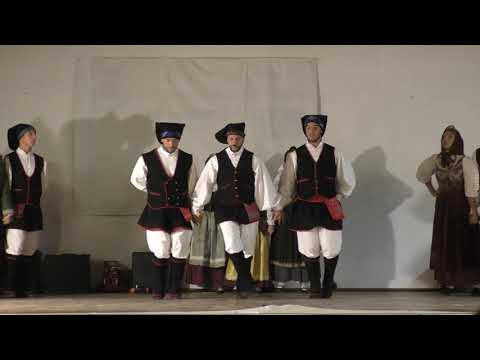
The traditional men’s wardrobe of Sestu also comprises two variants. The everyday dress features the berritta (cap), black woollen cloth, tubular with rounded edges, about sixty centimetres long, worn falling behind the head. The camisa (shirt), white cotton, is embroidered on the collar, chest, armhole and cuffs. The cropettu (waistcoat) is black orbace wool, brown fustian at the back, with brown velvet lapels and a central row of buttons. The gabbanu (short coat) is black orbace wool, hooded, reaching just below the waist; lapels, pockets and cuffs are brown velvet with black wool edging, and it has no fastening.
The cratzonis (breeches), white cotton, reach to mid-calf and are worn tucked into the gaiters. The arroda (short skirt) is black woollen cloth, pleated and edged with black satin, reaching to mid-thigh; a narrow strip of fabric joins the front and back panels under the breeches. The cratzas (gaiters) are black woollen cloth with an upper turn-down and velvet edging; they cover the calf and end rounded, concealing part of the shoes, fastened with a lace below the knee and a leather strap passing under the shoe.
The festive peasant dress is a simpler variant: it consists of a black woollen berritta held by a printed cotton scarf, a white cotton camisa, a black woollen cropettu, white cotton cratzonis, a black woollen arroda and black woollen cratzas.