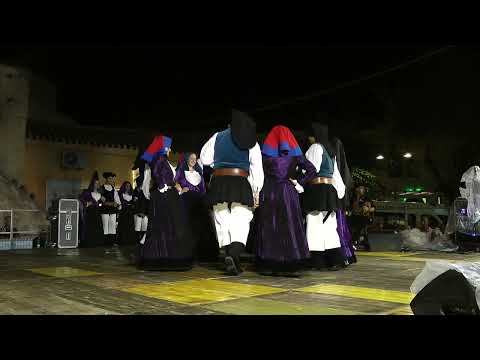
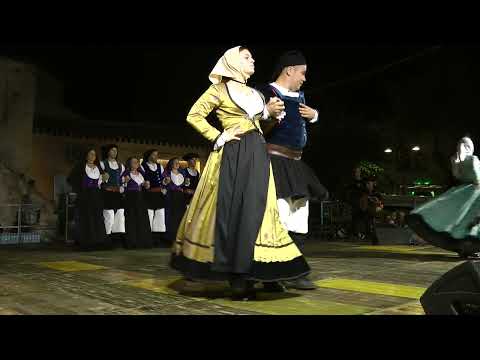
Historical background and roots of tradition
Tertenia is a village in the Ogliastra, nestled in a hilly landscape sloping towards the eastern coast of Sardinia, between the Salto di Quirra plateau and the Gulf of Cagliari. Its festive dress is one of the most distinctive in the region: violet Bemberg satin dominates both the women’s skirt and jacket, paired with a wide black lace mantle and a black satin apron. Alongside the everyday festive dress, Tertenia also preserves the precious estiri ’e sposa, the bridal dress in teal silk brocade, with a delicate green satin apron. The men’s dress stands out for its light-blue velvet double-breasted waistcoat worn over a richly gathered black cloth skirt.
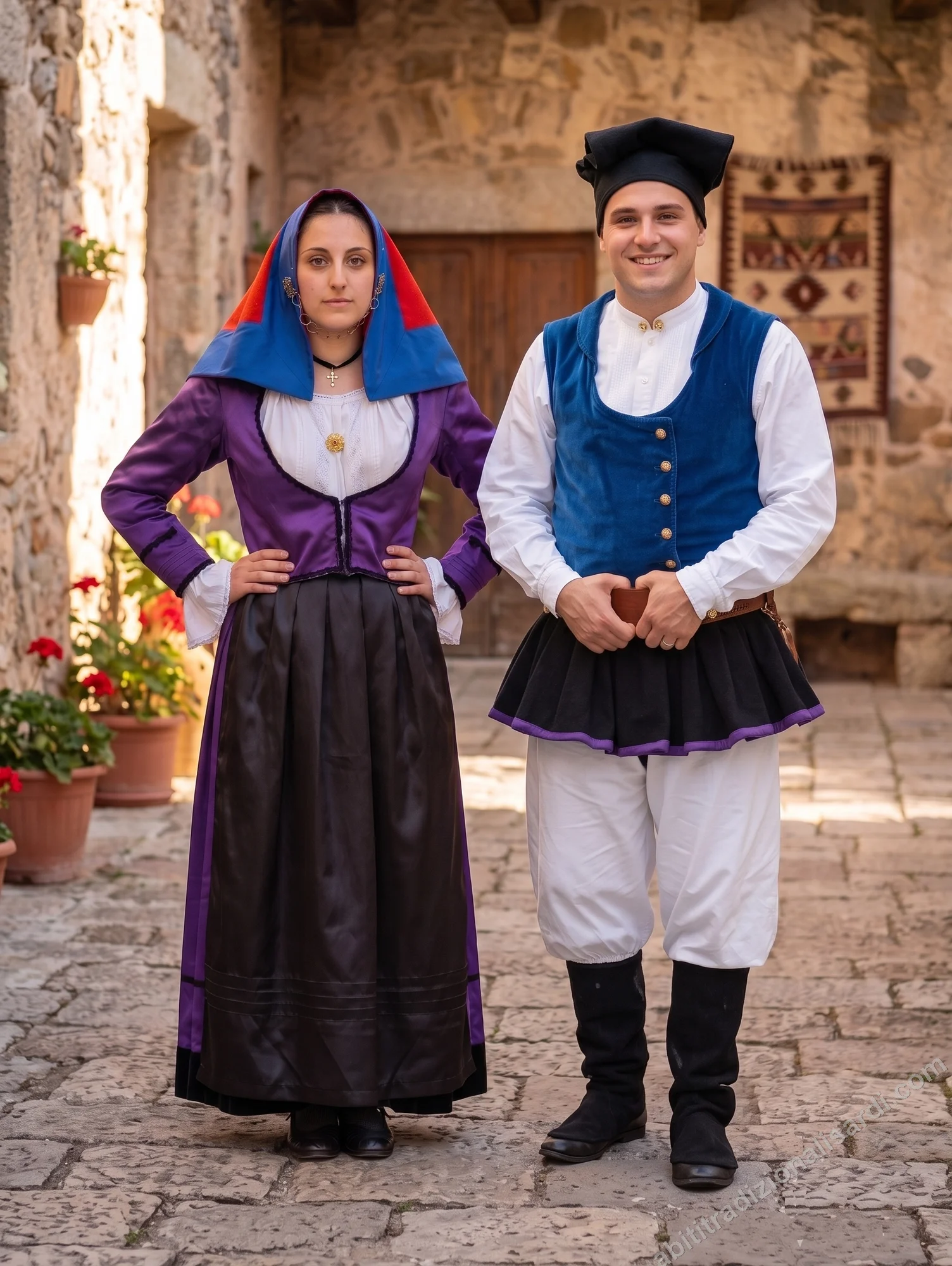
Women’s dress
On the head is worn su turbanti, a square of violet, brown, or black cloth tied in a characteristic fashion. Over the shoulders falls sa mantilla, the wide black lace mantle lined in violet satin. The shirt (sa camisa) is in white cotton or linen, with wide sleeves gathered at the wrists into a strozzatura, and a pleated front adorned with crochet lace inserts.
On the torso is worn su gipponi, the jacket in violet Bemberg satin with long tight sleeves, a wide neckline, waist hooks, and fan-shaped pleats at the back. The skirt (sa unnedda) is also in violet Bemberg satin: smooth at the front and finely pleated at the waist, it can reach up to seven metres in circumference; the hem is finished with a black velvet band of about 8 cm above which runs a black braid. Beneath is worn su suntanu, the white cotton or linen underskirt with a lace hem. The apron (s’antaleni) is in black satin with three horizontal tucks near the lower edge. On the feet are worn is cosingius, black leather lace-up shoes with a low heel.
Estiri ’e sposa (Bridal dress)
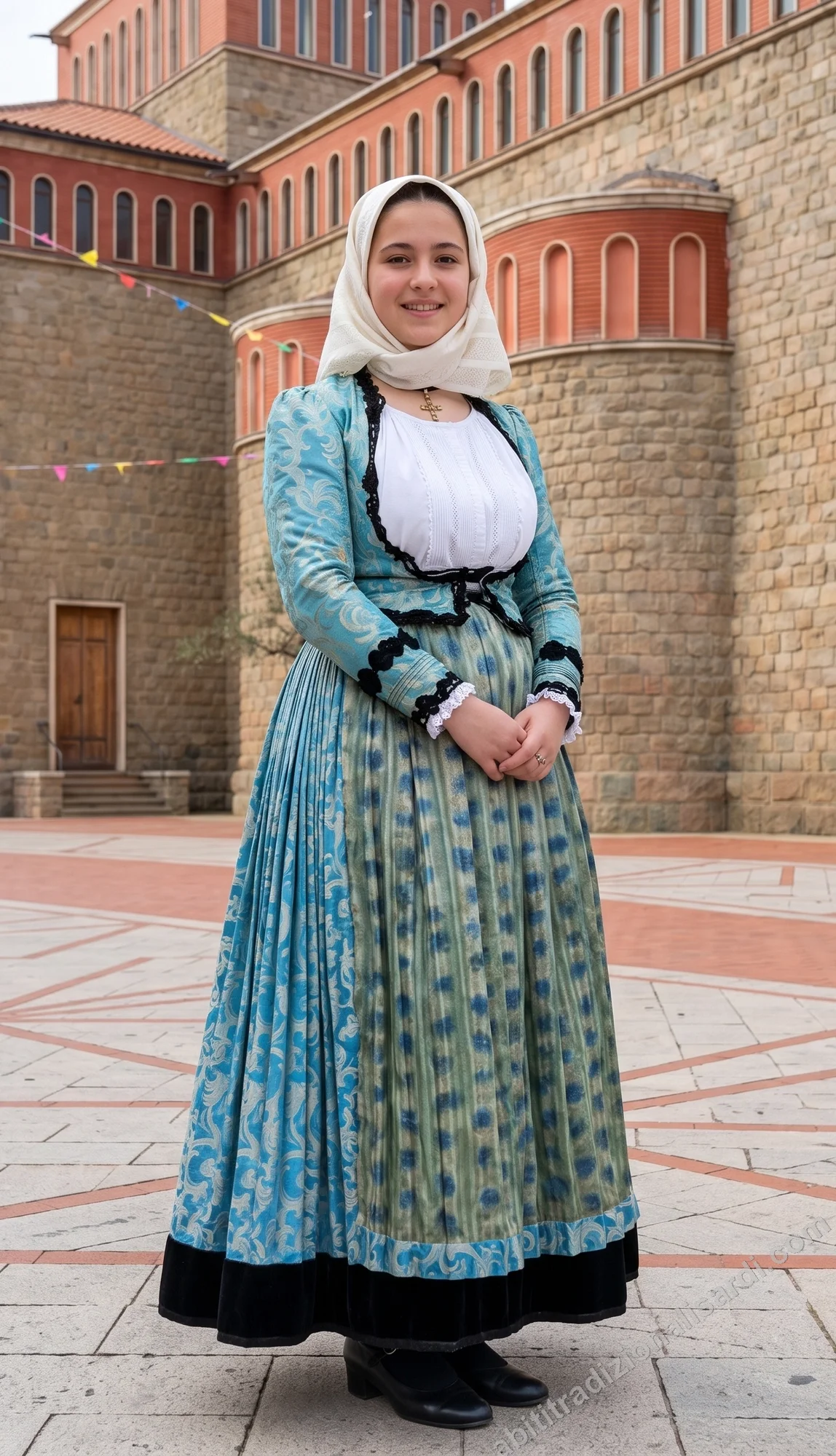
The headscarf (su muccadori) is beige in figured silk, square in shape: it is worn folded into a triangle, with the ends crossed under the chin and fastened inside at ear level. The shirt (sa camisa) is white in cotton, pleated at the front and embroidered on the chest and cuffs, is pulanias. The jacket (su gipponi) is teal in silk brocade, with a wide V-neckline; edged with black cotton braid, it is fastened at the front with hooks. The skirt (sa unnedda) is teal in silk brocade, fully pleated except for the front panel covered by the apron, with a black velvet flounce at the hem. The apron (s’antaleni) is green in satin, pleated.
Men’s dress
On the head is worn sa berritta, the bag-shaped cap in black cloth or orbace left loose over the shoulders. The shirt (sa cammisa) is in white cotton or linen and comes in two models: the older one features rich ruching on the sleeves and shoulders; the late-nineteenth-century model has lighter pleating. Both fasten at the cuffs with gold or mother-of-pearl buttons. On the torso is worn su croppettu, the double-breasted waistcoat in light-blue velvet with a round neckline and silver buttons on the left side.
Around the hips is worn is bragottis, the skirt in black cloth or orbace with rich gathering at the waist and a thin violet Bemberg satin border at the hem. The waist is cinched by sa brentera, a leather belt about 8 cm wide. Beneath are worn is bragas, wide white cotton or linen trousers gathered below the knee by is carzoneddus, the black cloth or orbace leggings covering the leg down to the upper foot. On the feet are worn is cosingius, black leather lace-up shoes.