Historical background and roots of tradition
Teulada, known in Sardinian Campidanese as Teulàda, is a village in the Sulcis, in the province of Sulcis Iglesiente, at the southernmost tip of Sardinia, overlooking one of the wildest and most spectacular stretches of coastline on the island. Both the Italian and Sardinian names derive from the Latin word tegula, meaning roof tile, recalling the ancient production of terracotta and tiles that took place in the area during the Roman era.

Women’s dress
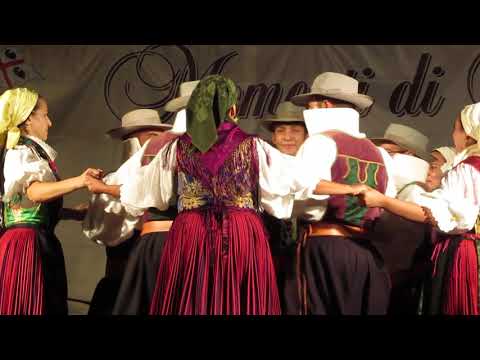
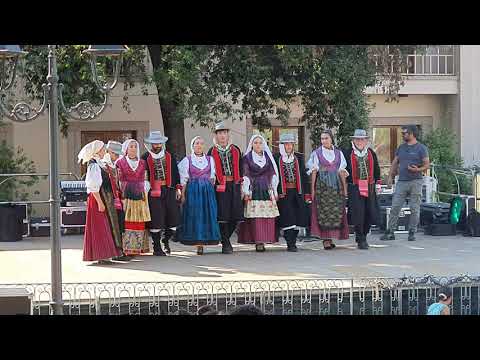
The everyday women’s dress is known as su boldau. The muncadori, a square beige tibet scarf embroidered with floral motifs and vine tendrils, is worn folded into a triangle, gathering the hair and tied behind the neck. The camisa, a white cotton shirt, has the chest, collar and cuffs embroidered in puntu ’a brodu and enriched with crocheted lace; the fullness of the fabric is gathered at the wrists and neckline with a pleated trim, frungidura, embroidered in puntu vanu, and is fastened at the wrists with a green ribbon and at the neck by two gold lamina and filigree buttons. The cossu, a blue bodice in polychrome floral brocade, is trimmed with red silk and enriched with beads and golden gimp, laced across the front with a crossed ribbon. The muncadori ’e tzugu, a black triangular tibet chest-covering shawl printed with polychrome floral motifs and with applied fringe along the edges, is worn by crossing the ends over the chest and tucking them into the skirt. The foldetta, a red and blue striped skirt in heavy cotton — bodrau — is fully pleated except for the front panel covered by the apron, and trimmed with green cotton. The diventali, a purple apron in patterned floral silk, is trimmed with black lace.
Men’s dress
The festive men’s dress is distinguished by the cappeddu, a wide-brimmed grey felt hat. The camisa, a white cotton shirt, has a tall collar hand-embroidered in puntu ’a brodu; further embroidery enriches the armholes and cuffs, in which the fabric fullness is gathered with a trim pleated in geometric motifs, puntu vanu; gold lamina and filigree buttons fasten the collar and cuffs. The cossu, a purple velvet double-breasted bodice with a square neckline and the back in black patterned silk, is trimmed with green satin; it has three rows of six buttons each, is embroidered with various motifs in polychrome cotton thread and bears a peahen embroidered in puntu ’a brodu on the left side; it is lined with checked cotton. The gipponi, a black orbace jacket trimmed with red cloth and green satin, is open at the front. The mudandas, white cotton breeches trimmed with lace, reaching mid-calf, are worn over the gaiters. The cratzonis, black orbace breeches reaching mid-calf, are trimmed with black velvet at the hem and also worn over the gaiters. The cratzas, black orbace gaiters trimmed with black velvet at the hem, cover the calf and end in a rounded shape, partially concealing the shoes, and are held in place with an elastic band below the knee.
Jewellery & Accessories
The accessories complete the costume: the cintu, a brown leather belt, and the giunchigliu, a silver chain with a locket containing a piece of brocade.
Main fabrics
Cotton, Brocade, Silk, Velvet, Orbace
Occasion
Religious festivals, everyday wear, folk parades
Events in Teulada
-
7–19 July
Su Cramu View →