Historical background and roots of tradition
Tuili, known in Sardinian as Tuìrhi, is a village in the Marmilla, in the province of Medio Campidano. It lies at the foot of the Giara plateau; in the Middle Ages it belonged to the Giudicato of Arborea.

Women’s dress
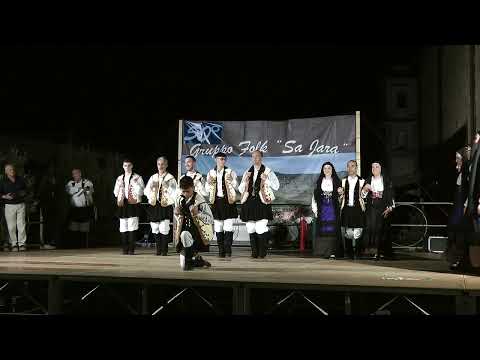
The muccadori, a square white cotton headscarf, is worn folded into a triangle: it gathers the hair and is tied at the back of the neck.
The sciallu, a square black wool shawl, is hand-embroidered with polychrome floral motifs and trimmed with applied fringe. It is worn folded into a triangle with the ends left loose.
The camisa, a white cotton shirt, features embroidery on the neckline, chest and cuffs.
The croppettu, a purple broccatello bodice, is edged with red velvet and gold passementerie, and fastened at the front with a crossed ribbon.
The unnedda, a brown woollen skirt, is fully pleated except for the front panel, which is covered by the apron.
The deventali, a purple damask satin apron, completes the festive women’s dress.
Men’s dress
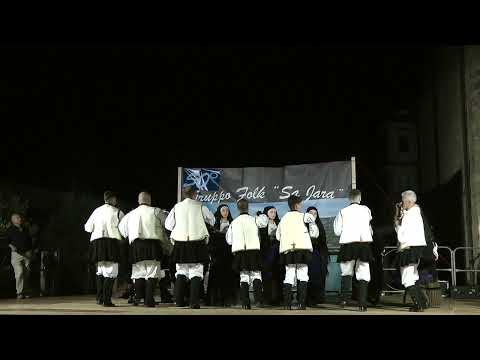
The berrita, a black tubular panno cap with rounded edges and about sixty centimetres long, is worn folded over and left to fall at the front.
The camisa, a white cotton shirt, is embroidered on the chest and cuffs.
The iste 'e peddi, a white lambskin waistcoat, has brown leather edging.
The cratzonis, white cotton trousers cut to mid-calf, are worn tucked into the gaiters.
The ragas, a black orbace kilt-skirt, is pleated and edged with black velvet, reaching mid-thigh; a narrow strip of fabric joins the front and back panels, passing between the legs.
The cratzas, black panno gaiters edged with black velvet, cover the calf and end in a rounded shape concealing part of the shoe; they fasten with a row of side buttons.
Main fabrics
Cotton, Wool, Broccatello, Satin, Velvet, Orbace, Leather
Occasion
Religious festivals, folk parades