Historical background and roots of tradition
Villaputzu, known in Sardinian as Biddepùtzi, is a village in the Sarrabus, in the province of Cagliari. The name combines “villa” (village) with the Campidanese Sardinian term putzu (well), first recorded in 1120 as Villa Pupia or Villa Pupus. The village lies on an alluvial plain of the Flumendosa river and is historically identified with the ancient Sarcapos, a commercial and port city at the mouth of the Flumendosa, abandoned from the 8th century following barbarian raids.

Women’s dress
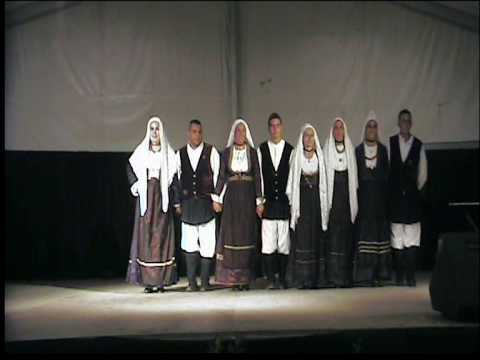
The information gathered refers to the bridal costume. The pannisceddu ‘e trogai, a red triangular cotton headscarf, gathers the hair and is tied at the nape. The pannisceddu ‘e seda, a white square silk headscarf, is worn folded into a triangle with the ends loose. The sciallu, a square silk shawl in black and violet with a woven pattern, is trimmed with fringe along the edges and worn folded into a triangle with the ends loose. The camisa, a white cotton blouse, is gathered at the chest and embroidered on the chest and cuffs. The cossu, a violet brocade bodice with polychrome floral motifs, fastens at the front with a silver chain. The gipponi, a violet silk jacket, is edged with green passementerie. The unnedda, a brown shot-silk skirt, is fully pleated except for the front panel covered by the apron. The deventali, a violet silk apron, completes the dress.
A festive variant also exists. A red cotton headscarf gathers the hair; the pannisceddu ‘e seda, a white square silk headscarf, is worn folded into a triangle. The velu, a white tulle veil, completes the headwear. The camisa, a white cotton blouse, forms the base of the dress. The cossu, a black and violet brocade bodice with polychrome floral motifs, fastens the dress at the front. The gipponi, a blue cloth jacket, covers the torso. The unnedda, a woollen skirt, covers the legs. The deventali, a violet silk apron, completes the dress.

Men’s dress
The information gathered refers to the everyday men’s costume. The berritta, a black cloth cap, covers the head. The camisa, a white cotton shirt, forms the base of the costume. A black cloth jacket covers the torso. The cratzonis, white cotton breeches, cover the legs. The cratzonis de arroba, a black cloth short skirt, is worn over the breeches. The cratzas, black cloth gaiters, complete the costume.
Main fabrics
Shot silk, Cotton, Brocade, Wool, Cloth
Occasion
Religious festivals, weddings, everyday wear
Events in Villaputzu
-
9–13 & 23–25 October
Santa Vittoria and San Narciso View →