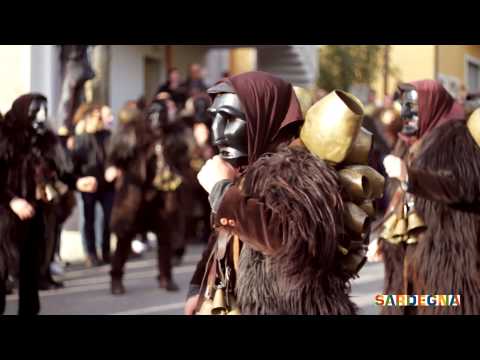
Mamuthones and Issohadores of Mamoiada
The Mamuthones and the Issohadores are the traditional masks of Mamoiada, a village in the Barbagia in the province of Nuoro, and the most famous figures of the Sardinian carnival. Their origins are very ancient and still debated: one of the most widespread readings sees the Issohadores as shepherds catching animals that have strayed from the flock, and the Mamuthones as a propitiatory rite for the year’s harvest. Every year the masks make their first outing on the evening of 16 January around the great bonfire of Sant’Antoni de su Ohu.

Su Mamuthone
The Mamuthone’s face mask — called visera — is made of blackened wood, crafted from fig, alder, elm, chestnut or walnut; wild pear was traditionally used in earlier times. It is secured to the face with leather straps and framed by a kerchief worn in a feminine style. The body is wrapped in the mastruca, black sheepskin, while on the back hangs the carriga: a graded cluster of cowbells that can reach a considerable weight.
S’Issohadore
The Issohadore is distinguished by a white mask and a vivid red waistcoat called curittu, paired with a white shirt and white trousers. On the head sits the berritta, a characteristic cap; across the shoulder a bandolier of small bronze bells, the sonajolos. The outfit is completed by a shawl, orbace wool leggings called cartzas, leather boots and the rope sa soha, used by the Issohadores to lasso women and girls in the crowd as a gesture of good fortune.
The parade
During the parade the Mamuthones advance in two parallel rows of equal number. The Issohadores are spread out in front and behind, except for su guidadore — the leader — who stands in the middle between the two rows: it is he who sets the pace and decides when to start and when to stop.
At his signal everyone begins to jump: the Issohadores, with small steps, untie sa soha and throw it into the crowd; the Mamuthones, focused, watch and follow su guidadore. The jump alternates “a intro” (inward) and “a foras” (outward), following an ancient and inimitable step. When the guidadore raises his hand, four jumps are counted; on the fourth comes sa doppia: three consecutive jumps on the spot, with the two rows facing each other. Then they set off again.
The closing signal is different: after raising his hand, on the second inward jump the guidadore spreads his arms. One last jump outward, then inward, and the final sa doppia brings the ritual to a close.
The rite and the calendar
The cycle of the masks opens in mid-January with Sant’Antoni de su Ohu: the evening of the 16th is Sa Prima Essia, the first outing around the bonfire lit in front of the church of Sant’Antonio Abate, and on the 17th the main parade takes place. Mamuthones and Issohadores return to the square on Carnival Sunday and Shrove Tuesday, when the parade closes the ritual cycle. During the year they can also be seen at Autunno in Barbagia in Mamoiada and at the parade of masks of the Sagra del Redentore in Nuoro, while in the village the Museum of Mediterranean Masks tells their story alongside other masks from across Europe. Related masks of the Barbagia include the Boes e Merdules of Ottana, the Thurpos of Orotelli and the Maimones of Olzai.
Type
Paired ritual masks
Materials
Blackened wood, Sheepskin, Cowbells, Orbace wool
Origin
Mamoiada (NU)
Dominant colours
Black (Mamuthone), White and Red (Issohadore)