Historical background and roots of tradition
Marrubiu, known in the local Campidanese variety as Arrùbiu or Marrùbiu, is a village in the Campidano di Oristano, in the province of Oristano, at the foot of Monte Arci. The origin of the name is uncertain: some suggest it comes from the Latin Mare Rubrum or Mare Rubio, or from horehound (Marrubium alysson), a medicinal plant common in the area; most scholars, however, consider it a word of probable pre-Latin origin. The area was frequented from the Neolithic onwards for the obsidian of Monte Arci, was home to many nuraghi and, in Roman times, to the Praetorium of Muru Is Bangius. In the Middle Ages the village of Zuradili arose within the Giudicato of Arborea; after 1420 it passed to the Marquisate of Oristano and from 1478 it was an Aragonese fief. In 1659 the inhabitants moved down to the plain, founding present-day Marrubiu. The patron saint is the Madonna del Rimedio.

Women’s dress
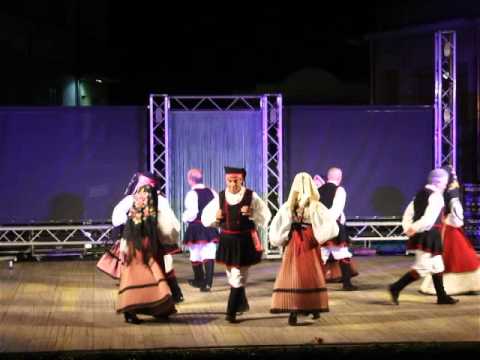
The women’s dress described here is the bridal one. On the head is the muncadori (headscarf), white patterned silk and square: it is folded into a triangle, with the ends crossed under the chin and tucked in at ear level. Over it lies the sciallu (shawl), brown tibet wool, square and trimmed with macramé fringes enriched with coloured silk threads; hand-embroidered with multicoloured floral motifs, it is folded into a triangle and pinned to the headscarf.
The camisa (shirt) is white cotton, high-necked, with Sangallo lace on the collar, cuffs and along the buttoning; purple embroidery further enriches the lace. The pabas (bodice) is white brocade with multicoloured florals, small, edged with light blue cotton tape and silk taffeta ribbons covered with black beads; it has three small rosettes at the back and is laced at the front with a fuchsia cord. The gipponi (short jacket) is purple patterned silk, small: the collar is edged with black silk ribbon patterned with multicoloured flowers, the lower edge with black velvet trimming, beads and silk ribbons; two coloured tassels are sewn on the front.
The gunnedda (skirt) is striped beige and burgundy, in cotton and silk, fully pleated except for the front panel covered by the apron, with two black lace flounces faded with wear. The panneddu (apron) is black silk velvet, edged with a bronze-coloured trim and a black cotton one with golden motifs.

Men’s dress
The men’s dress, for festive and everyday wear, includes the berritta (cap), black wool cloth, tubular with rounded edges and about sixty centimetres long, edged with red velvet ribbon and worn folded to one side. The camisa (shirt) is white cotton with embroidered chest, collar and cuffs; silver filigree buttons close the collar and cuffs. The cropettu (waistcoat) is black wool cloth, edged with red velvet and double-breasted.
The cratzonis (trousers) are white cotton, mid-calf length, tucked into the gaiters. Over them goes the cratzonis ’e arroda (kilt), black wool cloth, pleated and edged with red velvet, reaching mid-thigh: a thin strip of fabric joins its front and back, passing under the crotch of the trousers. The cratzas (gaiters) are black wool cloth with a turned-down top edged with red velvet; they cover the calf and end in a rounded shape, hiding part of the shoes, and are tied with a lace below the knee.
Main fabrics
Silk, Tibet wool, Cotton, Brocade, Velvet, Wool cloth
Occasion
Weddings (women’s bridal dress); feasts and everyday life (men’s dress)
Events in Marrubiu
-
5–8 September
Madonna del Rimedio View →