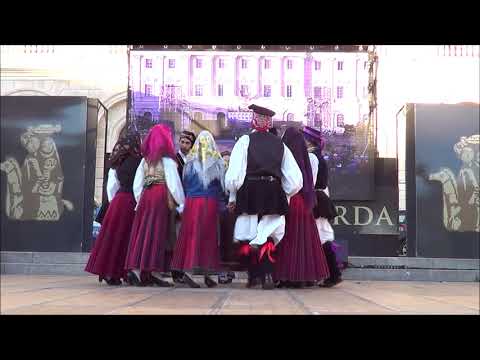
Historical background and roots of tradition
Maracalagonis, known in Sardinian as Mara de Calagonis and anciently as Mara, is a village in the Campidano, in the Province of Cagliari. The place name combines the Phoenician-Sardinian root mara (from hamara, "salt marsh") with the name of the vanished medieval village of Calagonis, perhaps from the Phoenician-Punic chalaca ("fertile place"): by 1416 the settlement was already known as "Mara de Calagonis". The territory lies at the foot of the Sette Fratelli massif, covered by the Regional Forest, and preserves nuraghi, domus de janas and giants' tombs attesting to uninterrupted human settlement since the Neolithic. In the Giudicato period the village belonged to the Giudicato of Cagliari; after the Aragonese conquest of the 14th century it passed through various feudal lords, until the abolition of feudalism in 1839. Today Maracalagonis is known for its DOC Campidanese wines, the Sette Fratelli Regional Forest and the lively Sagra de Su Pani e Sa Tomata, held every September.

Women’s dress
The bridal dress of Maracalagonis, the bistiri a spensu, is one of the most sumptuous in the Campidano. On the head women wear the muccadori, a square scarf in white figured silk folded into a triangle with the ends loose, and the sciallu, a shawl in antique-violet and green figured silk with floral motifs and fringed edges, also folded into a triangle. The camisa — a white cotton shirt with lace on collar and cuffs — is worn under the spensu, a closely fitted jacket in black and red silk decorated with appliqués of figured velvet with black and fuchsia floral motifs on a violet ground, embellished with sequins, black passementerie and gold bullion; the tight pleated sleeve has a puff at the elbow. The gunnedda is the fully pleated cotton skirt — except for the front panel covered by the apron — lined inside with raw linen. The deventali is the black silk apron, hand-embroidered with polychrome floral motifs, finished with gold bullion and black lace at the border. The crapittas de coja are the bridal shoes in leather covered with green brocade: for good luck, a coin was slipped inside the shoe on the wedding day.
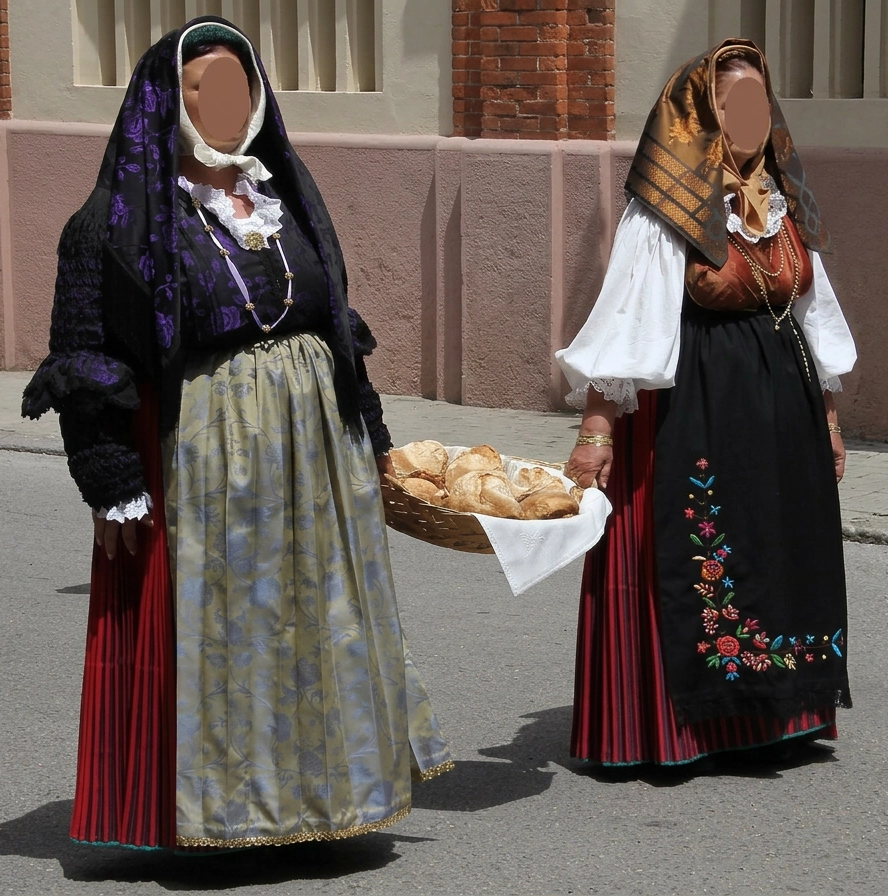
The festive dress of Maracalagonis is known as "a perra de canna o a manica de camisa": it is worn without the jacket, with the shirt visible, and the sleeve is ironed to form six pleats divided by a larger central pleat — "a perra de canna" (a piece of cane). The dress comprises: a straw-yellow silk headscarf; a white cotton shirt; a white velvet bodice with the back in polychrome floral brocade; a yellow silk chest kerchief called pann’e pittura; a red-and-blue striped cotton skirt; a printed brown cotton apron; a belt in gold braid.

Men’s dress
The men’s festive dress, called bistiri a crazzas, consists of: berritta, a black cloth cap; camisa, a white cotton shirt; cropettu, a black velvet waistcoat; sereniccu, a short black orbace coat edged with bordeaux velvet; cratzonis, white cotton trousers; arrodinu, a black orbace kilt-like skirt; cratzas, black cloth gaiters; carrighera, a brown leather belt covered in blue silk and gold braid, with gold tassels sewn at the sides and cartridge compartments inside.
Jewelry & Accessories
The jewellery of the Maracalagonis bridal dress reflects the refined goldsmith tradition of the Campidano. The arreccadas are earrings in gold and baroque pearls; the cannacca is a gold necklace and the lasu a gold pendant. The patena, with a gold chain, encloses in a locket a relic on one side and an image of Our Lady of Lourdes on the other. The busciacca, a violet silk pocket hand-embroidered with polychrome floral motifs, and the giunchillu, a silver chain fitted with nail cleaner and ear pick, complete the bridal trousseau.
Main fabrics
Silk, Cotton, Velvet, Orbace, Brocade
Occasion
Festive and bridal dress
Events
-
5–6 September
Sagra de su Pani e sa Tomata Discover