Historical background and roots of tradition
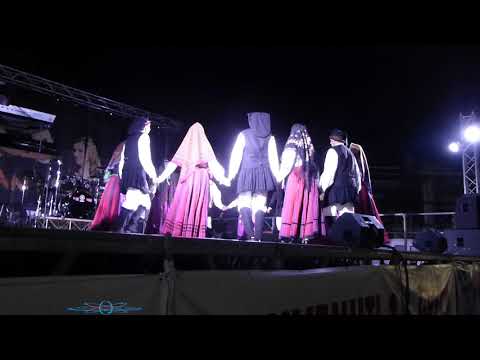
Nuraminis, known in Sardinian as Nuràminis, is a village in the Nuraminisi area, in the Province of Cagliari. The place name, first recorded in 1341 as de Noramine, has pre-Roman origins: the main hypotheses trace it back to the Proto-Sardinian element nur, meaning a chasm, cavity or heap of stones, referring to the karst features of the territory and the presence of nuragic remains, or to the combination of nura/mura (heap of stones) with the Neo-Latin suffix -mini, indicating a rocky or stony area. The village lies in the fertile Campidano plain, along the route linking Cagliari and Oristano, and its territory preserves evidence of human settlement since prehistoric times. The local architectural heritage, including rural churches and nuragic structures, reflects the continuity of this community across the centuries. The traditional dress, with the vibrant colours of the embroidered bodice and the red-and-blue striped skirt, remains a symbol of local identity at religious festivals and folk parades.
Women’s dress
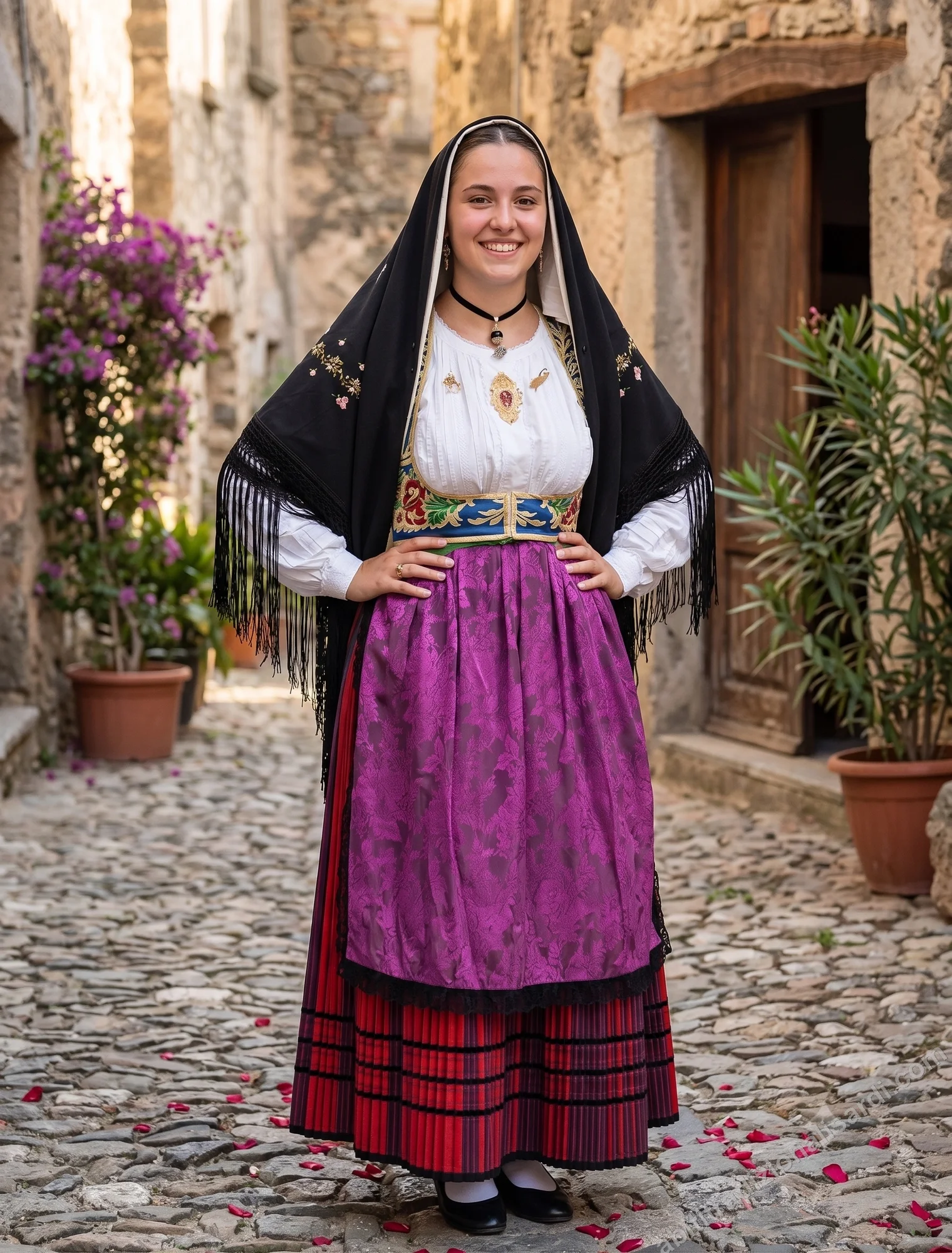
The everyday women’s dress of Nuraminis is distinguished by its rich fabrics and vibrant colours. The head covering is a muncadori (headscarf) in red cotton, triangular in shape, which gathers the hair and ties at the back of the neck; alternatively a white muncadori in woven silk is worn, square and folded into a triangle with the ends hanging free, or a sciallu (shawl) in printed brown cotton with violet and green fringes along the edges. The bodice consists of a white cotton camisa (blouse), pleated at the chest and trimmed with lace on the chest and cuffs, paired with a cossu (bodice) in beige polychrome floral brocade, edged with red ribbon and tied at the front with crossed red ribbons. The gunnedda (skirt) is in red-and-blue striped cotton, fully pleated except for the front panel covered by the davantagliu (apron) in violet floral woven silk; the lower edge of the skirt is trimmed with two black velvet ribbons and black beaded passementerie.
Men’s dress
The men’s dress, worn both daily and for festive occasions, features the barritta (beret) in black wool cloth, tubular in shape and about sixty centimetres long, left to fall over one shoulder; a red printed cotton handkerchief encircles the forehead and ties at the back of the head. The bodice consists of a white cotton camisa with lace on the chest and cuffs, and a black velvet cropettu (waistcoat) with central buttons. The lower garments include the catzonis (breeches) in white cotton, reaching mid-calf and tucked into the gaiters, the cratzonis de arroba (kilt) in black wool cloth, pleated and edged with black velvet, reaching mid-thigh, and the cratzas (gaiters) in black wool cloth with a velvet-edged upper cuff, covering the calf and ending in a rounded edge partially hidden by the shoes.
Main fabrics
Cotton, silk, brocade, velvet, woollen cloth
Occasion
Religious festivals, folk parades