Historical background and roots of tradition
Nurri, known in Sardinian as Nùrri, is a village in the Sarcidano region, in the Province of Sud Sardegna. The name derives from the ancient proto-Sardinian root nur, the same root found in the word “nuraghe”, bearing witness to a very ancient human presence confirmed by the numerous nuraghi and domus de janas found throughout the territory. The village lies on a basalt plateau in the heart of south-central Sardinia, and its history is intertwined with that of the Giudicato di Cagliari and later with Aragonese overlordship. The festive costume, with its vivid colours and precious fabrics, reflects an artisanal tradition that has preserved over the centuries the forms and symbols of Sarcidanese identity.

Women’s dress
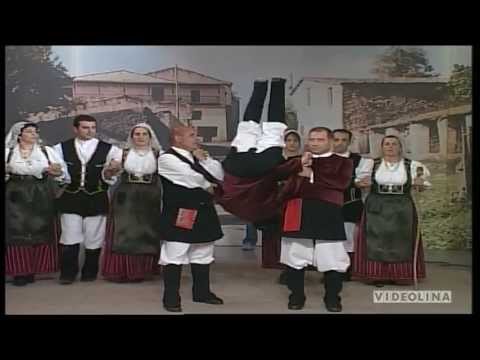
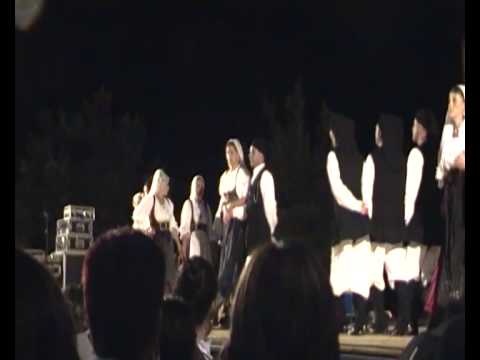
The festive women’s dress of Nurri is defined by the contrast between the white of the veil and shirt and the black of the fringed apron. On the head is worn the velu, a delicate white lace veil. Beneath, sa camisa is a white cotton shirt hand-embroidered, with embroidery visible at the collar. The bodice — su cossu — is white, in floral brocade; over it is worn the deventali, the large black lace apron with a fringed border and polychrome floral embroidery (roses, wheat ears, daisies) that covers the bodice down to the waist. The skirt — s’unnedda de bordau — is red and blue, pleated, with an embroidered brocade hem running along the lower edge.
Men’s dress
The festive men’s dress is sober and monochromatic, built around black orbace. On the head is worn sa berritta, the black orbace cap. Sa camisa is the white cotton shirt, fastened at the collar with small bone buttons. On the body is worn su cropettu, the black orbace vest with front fastening. The white cotton breeches — ragas de tela — are wide-cut and fall softly; over them is worn the black orbace overskirt. The legs are covered by the cratzas, the black orbace gaiters.
Main fabrics
Cotton, Brocade, Orbace, Lace
Occasion
Festive
Events in Nurri
-
1–6 September
Santa Rosa da Viterbo Go →