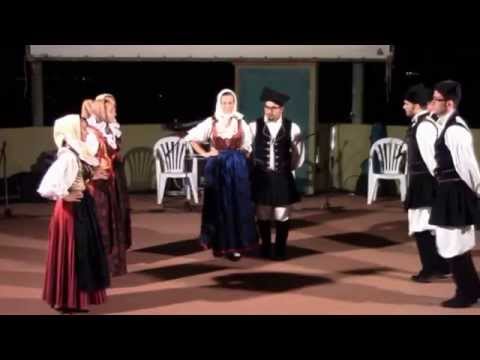
Historical background and roots of tradition
Sarroch, known in Sardinian as Sarrocu, is a village in the Nora region, in the province of Cagliari. Its name may derive from the Sardinian sa rocca or the old Catalan s’arroch, both meaning “the rock”, referring to the hill and the large volcanic rock in the territory (Sa Rocca de Mont’e Gravellus). The village overlooks the western coast of the Gulf of Angels, about 25 km from Cagliari.

Women’s dress
The women’s festive dress of Sarroch combines finely crafted garments. The muccadori (headscarf) is white in mixed operated silk, square; worn folded into a triangle and tied under the chin. Over it falls the sciallu (shawl), black tibet, square, with applied fringe along the edges and polychrome floral embroidery; worn folded triangular with the ends left free. The gipponi (jacket) is black operated silk; the front consists of two parts: the inner one, shaped like a bodice and closed with hooks, carries a chest piece with a high collar in black tulle on a light ground; the outer one closes at the centre with press-stud buttons. The fordetta (skirt) is red and blue cotton, fully pleated except for the front panel covered by the apron. The deventali (apron) is black damascene satin.
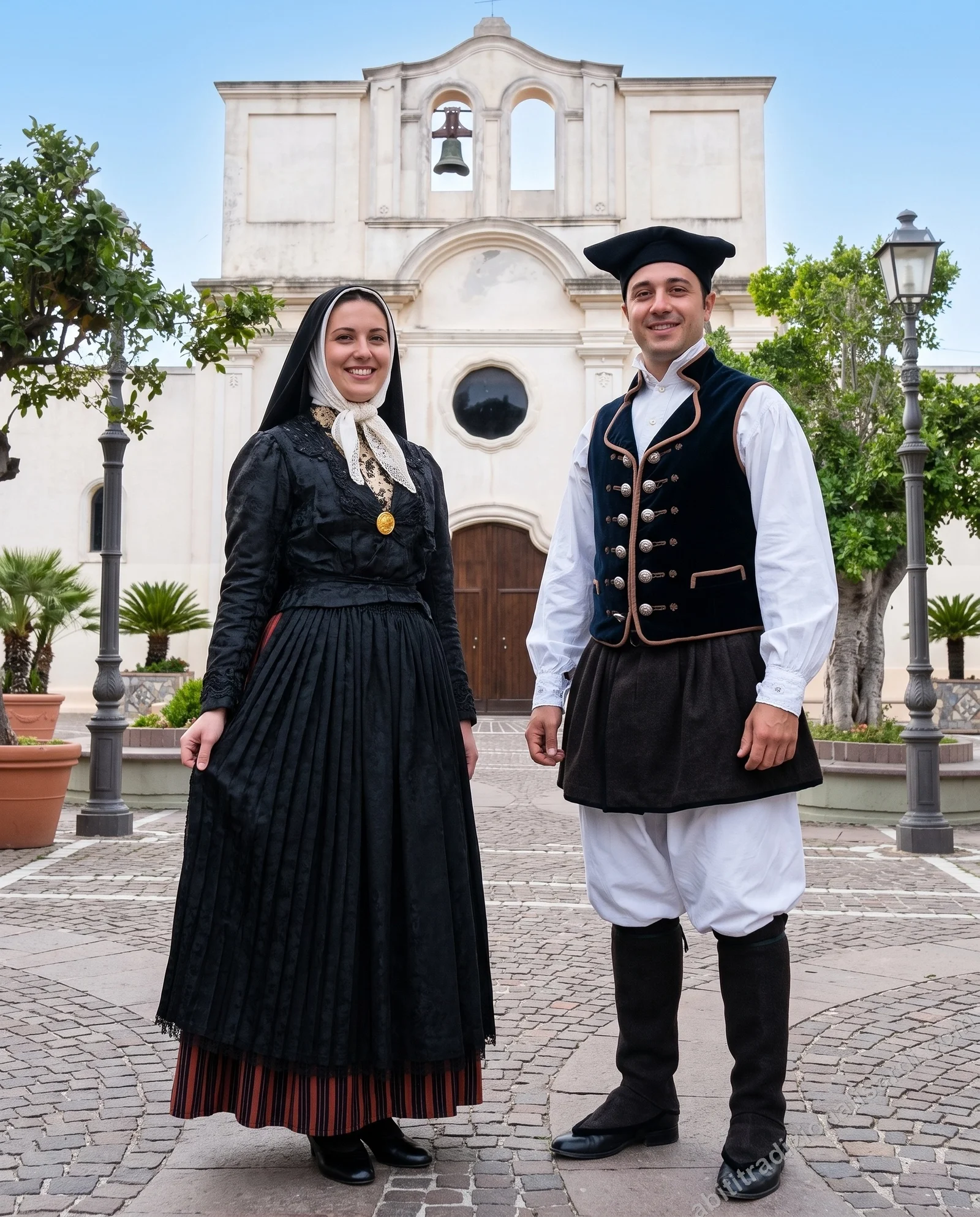
Men’s dress
The men’s festive dress comprises the berritta (black cloth cap), the camisa (white cotton shirt), the cropettu (dark blue velvet waistcoat), the cratzonis (white cotton trousers), the bragas (black cloth short skirt) and the cratzas (black cloth gaiters).
Main fabrics
Operated silk, Tibet, Cotton, Damascene satin, Velvet, Cloth
Occasion
Religious festivals, folk parades
Events in Sarroch
-
18–21 September
Santa Vittoria View →