Historical background and roots of tradition
Sassari, known in Sardinian as Tattàri, is the main city of northern Sardinia and the second largest on the island. Its name, attested in medieval documents from 1113 in the form Thathari, has an origin still debated among linguists: it may derive from an ancient root referring to the pebbles of local streams, or from the term tataroju, linked to a wild plant typically widespread in the area. The provincial capital, university seat and cultural hub of northern Sardinia, the city still bears in its festive costume the marks of the strong Iberian imprint acquired under Aragonese and Spanish domination.

Women’s dress
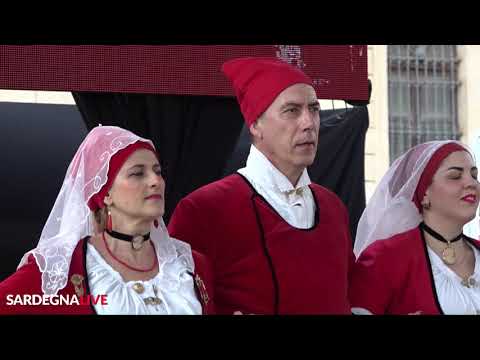
The women’s gala dress of Sassari is among the most elaborate in northern Sardinia. The caretta is a red silk cap that gathers the hair; over it sits the muccaloru di capu, a veil in hand-embroidered floral tulle lace. The camisgia (shirt) is white cotton with applied crochet lace. The cossu (bodice) is beige brocade. The corittu (jacket) is red velvet, double-breasted, edged with black velvet, and enriched on the sleeves by five gold buttons on each side. The faldetta (skirt) is bordeaux velvet trimmed with black velvet passementerie. The panneddu (apron) is cotton tulle edged with French filet lace.

Men’s dress
The men’s festive dress of the landowner class comprises the berritta a becciu (red cloth cap), the camisgia (white cotton shirt), the corittu (red cloth jacket), white cotton trousers, the ragas (black orbace short skirt) and the calzetti (black orbace gaiters).
The everyday dress has been reconstructed and is characterised by the leather overgarment known as lu cugliettu. Numerous iconographic records document its historical use: Imurza Sassarese e Sassaresi alle lattughe by Cominotti, Uomo di Sassari from the Luzzietti collection, Antiche fogge sassaresi by Simone Manca di Mores, and Zappatore sassarese by Baldassarre Luciano.
Main fabrics
Velvet, Brocade, Cotton, Tulle, Orbace, Leather
Occasion
Religious festivals, everyday wear, folk parades