Historical background and roots of tradition
Sindia is a village in the Planargia region, in the province of Nuoro, situated at 509 metres above sea level on the Campeda plateau, bordering the historic regions of Marghine and Montiferru. The name, of uncertain pre-Roman origin, is documented with certainty from the twelfth century in the Condaghe di San Nicola di Trullas: local historical studies suggest it derives from a root meaning cliff or steep terrain, owing to the landscape near the salto di Banzu; a more recent popular legend proposes the Latin sine die (“without a day”), linked to the ancient dense forests of the area. The territory preserves over forty nuraghi, while the medieval settlement developed around the church of San Pietro, built by Cistercian monks around 1150.

Women’s dress
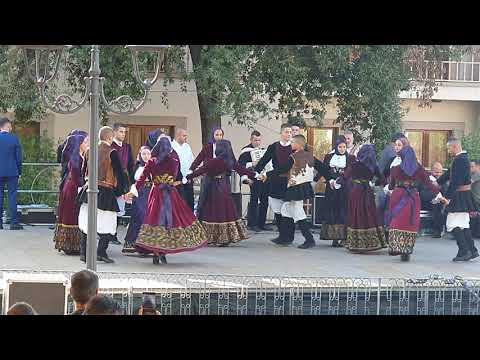
The women’s dress of Sindia is characterised by great chromatic elegance, dominated by the warm tones of bordeaux and violet. Women wear a plain bordeaux velvet skirt, often adorned with a floral flounce, paired with a bodice of the same colour, cinched at the waist and hand-embroidered.
Beneath the bodice the white cotton shirt is visible, finely decorated at the cuffs and chest. The apron, in a deep violet, echoes the tones of the black or violet headscarf: a layering that unites modesty and pride.
Men’s dress
The men’s dress expresses sobriety and strength through the contrast between white cotton and black orbace. Men wear a white shirt fastened by small filigree buttons, covered by a black velvet jacket with a bordeaux bib. A brown leather waistcoat and matching belt add a touch of rusticity, while the white trousers are tucked into orbace leggings. The headdress is su bonette, the classic black cap that frames the face with austerity.
Main fabrics
Velvet, Cotton, Orbace
Occasion
Religious festivals, folk parades
Events in Sindia
-
30 August – 9 September
Nostra Signora di Corte View →