The Traditional Dress of Gairo
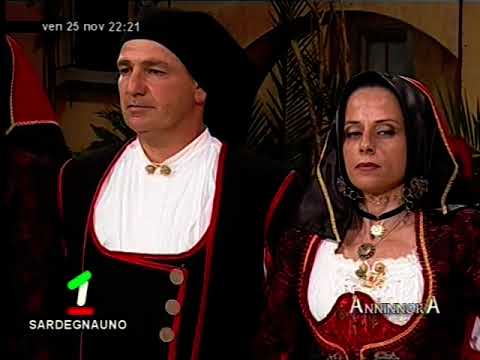
Gairo, known in Sardinian as Gàiru, is a village in the Baronia region, in the Province of Nuoro. The most widely accepted theory traces its name to the Greek words ga (earth) and roa (flowing, crumbling), giving the meaning of “flowing land”: a reference to the territory’s hydrogeological fragility, tragically confirmed in 1951 when flooding forced the abandonment of the old settlement, now known as Gairo Vecchio. The village’s vestimentary tradition stands out for its chromatic elegance, founded on the contrast between the deep black of the fabrics and the red accents that characterise both the male and female costumes: cloth, orbace and silk combine in a visually cohesive ensemble that expresses the cultural identity of the territory.

Women’s dress
The headdress consists of two overlapping elements: su trubanti, the dark base cap tied tightly at the nape, and su colori, the red headscarf with a black border placed on top — the colour of the border historically indicated a woman’s marital status. This second element is circular at the back and smooth at the front, fastened under the chin by a silver chain called sa gancera. For more ancient and solemn occasions, su sciallu ’e conca is worn instead: a long shawl reaching the shoulders in dark silk with floral patterns or in embroidered tibet cloth.
Sa camisa is the cotton shirt with puffed sleeves, enriched with lace at the shoulders and wrists and decorated on the chest with geometric embroidery and small pleats. Over it sits su cossettu, the fitted dark silk waistcoat with stays (ir balenas) to support the chest, fastened at the centre with hooks. Above the cossettu goes the female su gipponi: a fitted dark silk jacket with wide necklines and red borders, decorated with triangular cuffs, silver hooks and pleated fabric inserts (is alas) to add volume at the hips.
Sa fardetta is the long skirt in floral silk, smooth at the front and densely pleated at the back; ancient versions featured a three-layer reinforced hem (s’impanna) to withstand the wear of daily labour. Layered over the skirt is s’antaleni, the apron in usually black silk, slightly shorter than the skirt beneath it.
Men’s dress
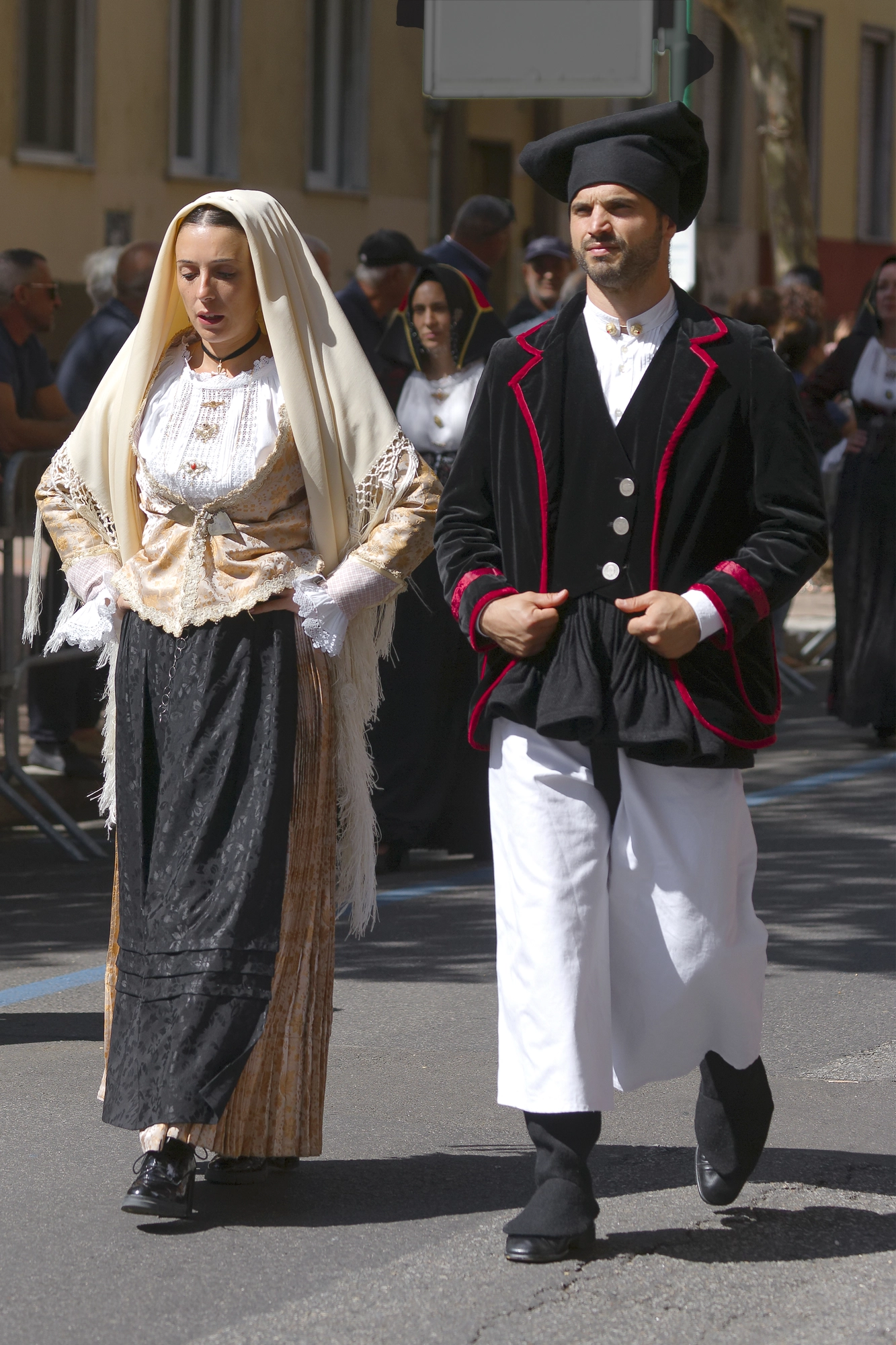
On the head is worn sa berritta, the long tubular cap in black cloth — originally in orbace — which can be shaped in different ways: folded on the head, left to fall down the back or over the chest. The shirt (sa camisa) is in white linen with wide sleeves, a Mandarin collar, side pleats and central embroidery.
On the torso is worn su gipponi, the short jacket in black cloth bordered in red, to be worn over the shirt: the inner sleeves are open, the cuffs are red turn-backs and the closure is asymmetric with silver buttons or coins. Above it sits su croppettu, the fitted waistcoat in black cloth with red borders and side pockets, reaching halfway down the kilt. At the waist is fastened s’entrera, the pouch belt in light leather used to carry a knife and flint.
S’areghettu is the kilt in black orbace bordered in red, pleated at the top and secured at the waist; a cord called su tira en’bolla fastens it by passing under the crotch. Beneath are worn s’araga, the wide white cotton or linen trousers tied at the waist and tucked into the leggings, and is carsas, the black orbace leggings with a red lower border fastened below the knee. On the feet are worn is cosingius, the classic leather shoes of the Sardinian shepherds.