The Traditional Costume of Galtellì
Galtellì, known in Sardinian as Gartèddi, is a village of the Baronia, in the province of Nuoro, set at 35 metres above sea level in the lower Cedrino valley. The name most likely derives from the Latin castellum, with reference to the Castello di Pontes, a medieval fortress built to control the valley; other interpretations link it to a Greek-Byzantine root meaning stronghold or fortified refuge. In the Middle Ages Galtellì belonged to the Giudicato di Gallura as the chief town of the curatoria of Orosei, before that role passed to Orosei itself.

Women’s dress
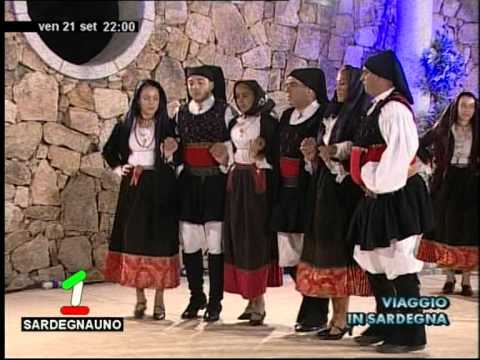
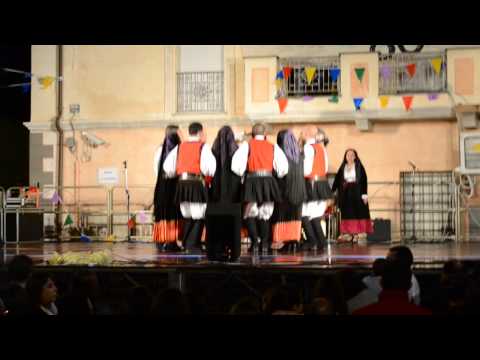
The women’s festive costume of Galtellì features the muccatore, a square brown tibet headscarf worn folded into a triangle with the ends crossed under the chin and tucked in at ear level. Beneath it sits the copribustu, a sleeveless white cotton bodice reaching the waist, whose neckline is trimmed with embroidered tulle. Sa camisa, the white cotton shirt, has the fabric gathered at the neckline and cuffs with an embroidered pleating of stylised motifs, sos coros; additional embroideries, sas baghiglias, enrich the neckline and cuffs. A thin embroidered chest piece is pinned to the breast with a brooch, and the neckline is fastened with gold filigree buttons. The zustillu, the bodice in blue polychrome floral brocade, is of small dimensions, edged with a red satin ribbon and laced at the front with a cord. The zippone, the jacket in black worked velvet on a burgundy red satin ground, is edged with bronze passementerie and a pleated violet satin ribbon; it has no buttons and is worn open at the front. The tunica, the white cotton underskirt, is bordered with sangallo lace. The fardetta, the brown orbace skirt, is fully pleated except for the front panel and has a wide red satin border; at the waist it features a double pleat that then opens into free pleats. The two longitudinal openings on the front panel are lined with red polychrome floral brocade, sas mascheras. A fabric cushion, su chirchu, is fastened at the waist to lift the skirt and give it its characteristic shape.
Men’s dress
The men’s everyday costume of Galtellì features the berritta, a black cloth tubular cap with rounded edges, about sixty centimetres long, worn falling behind the head. Sa camisa, the white cotton shirt, has the fabric gathered at the neckline and cuffs with pleating; the collar is fastened with gold filigree buttons. The gabbanu, a short black orbace coat with a hood, is edged with black velvet; reaching just below the waist, it has lapels and sleeves in black velvet with longitudinal stitching, and pockets enriched with tassels. The grozza jacket, in small-sized black orbace, has black velvet inserts and a sleeve with an outer opening on the forearm; it is worn over the imbustu, a red cloth bodice with an organza and velvet insert on the front. The cartzones, white cotton trousers reaching mid-calf, are worn tucked into the gaiters. The cartzones de uresi, the pleated black orbace kilt reaching mid-thigh, is connected by a thin strip of fabric passing under the crotch of the trousers to join the front and back panels. The cartzas, black orbace gaiters with an upper turn-down cuff, cover the calf and end in a rounded shape concealing part of the shoes; they are fastened below the knee with a lace. The chintoria, the brown leather belt, has worked inserts of various patterns.