Historical background and roots of tradition
Urzulei, Orthullè in Sardinian, is a village in the Ogliastra, in the province of Nuoro, perched on the limestone walls of the Supramonte and overlooking the Gorropu Gorge, one of the deepest canyons in Europe. Traditionally devoted to farming and herding, the village preserves a territory of extraordinary natural value, dominated by limestone gorges, holm-oak woods and the heights of the plateau. The name most likely derives from an ancient proto-Sardinian or Sardinian plant name, linked to sarsaparilla or other climbing plants typical of the Mediterranean scrub that once characterised the surrounding landscape.
Women’s dress
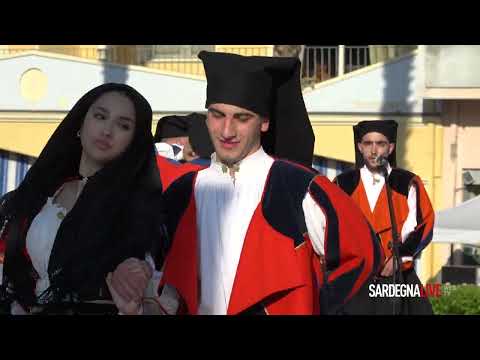
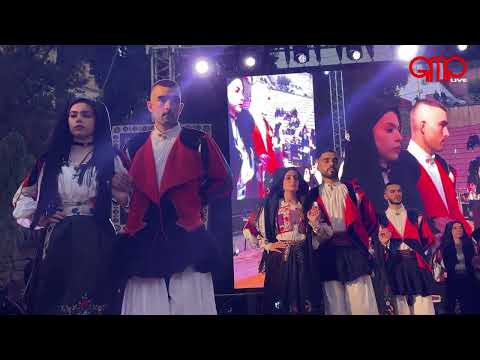
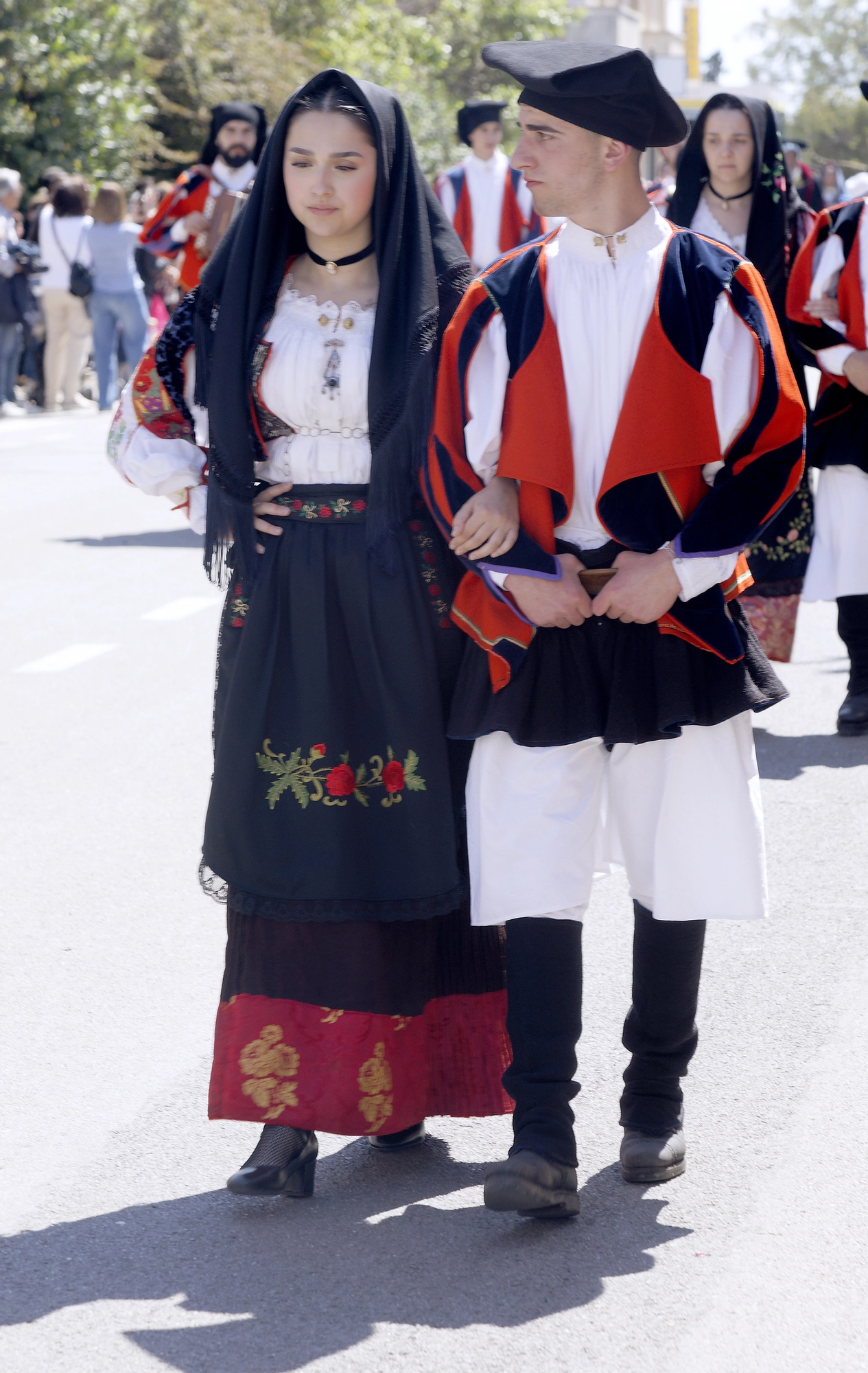
The headdress is su pannucciu, a square tibet cloth veil in dark tones (plum, coffee or black), folded into a triangle and draped over an elaborate braided hairstyle; the outer edge is trimmed with wide hand-worked silk fringe.
Su cippone is a short bolero in red cloth for formal occasions, with prominent puffed sleeves (manipuli); the lower sleeve from elbow to wrist is in cream silk brocade with coloured floral motifs. The stitching is done by hand with yellow and green thread. The bolero remains open at the front. Su cosso, the velvet corsage, is visible on the chest with floral decoration, held closed by silver hooks and a small chain.
The shirt (sa camisa) is in fine cotton with full sleeves; collar and cuffs are needle-worked with openwork motifs. The skirt (sa tuniha) is in black orbace wool with pleats (as prinnihasa) and a lower brocade hem with coloured floral embroidery. The apron (s’antalena) is in black satin with lace trim and silk embroidery along the hem.

Men’s dress
Sa berritta is the cylindrical black wool cap, folded so that part protrudes at the front and the rest falls back over the nape. The men’s su cippone is in red cloth with an open double breast; the sleeves are open at the front and trimmed with velvet. The shirt (sa camisa) is in pleated white linen with a stand collar and gold buttons.
Sa raha, a short skirt in black orbace, is worn over sa raha bianca, a voluminous gathered skirt in white linen or cotton. The leather belt (sa hintorgia) is finely worked and embroidered.