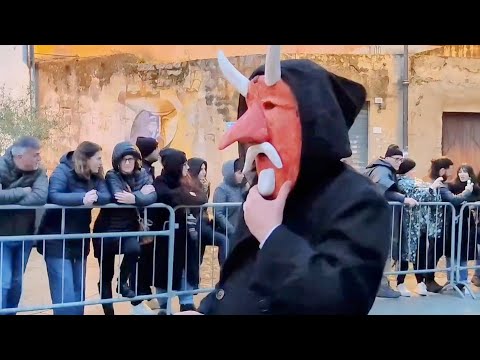
Su Bundhu of Orani
Su Bundhu (or Su Bundu, plural Sos Bundhos) is the traditional carnival mask of Orani, a village in the Barbagia di Ollolai in the province of Nuoro: a half-human, half-bovine figure representing the bond between man and animal and the farming roots of the community. The earliest evidence dates back to 1772, when a Jesuit friar visiting Orani noted a figure dressed as a Bundhu walking around with su Maimone. Every year the mask also takes centre stage during Autunno in Barbagia in Orani, with demonstrations of how it is made.

The mask
The Su Bundhu mask covers the wearer’s whole face. It has the oval shape of a human face but with strongly accentuated, deliberately prominent features such as the nose, double chin and moustache; the long ox horns on the forehead mark the union of human and animal. It is made entirely of cork, with the face and nose painted blood red — very probably ox blood was used in the past — while the moustache, chin and horns are white. Local craftsmen still select the cork, boil it and carve it by hand before the final painting.
The clothing and the pitchfork
Su Bundhu wears peasant clothing: su saccu, a wide, long orbace coat, a shirt, velvet trousers and leather leggings. In his hand he holds su trivutzu, a wooden pitchfork carved from a single branch, with which he mimes sowing.
The rite and the calendar
The carnival of Orani opens on 16 January with the bonfires of Sant’Antonio Abate; on the 17th the Bundhos make their first outing, visit the newly lit fires and receive su pistiddu, the traditional sweet blessed during the procession. Wandering through the village, Sos Bundhos make a great clamour mixed with moans, recalling souls in torment; they mime sowing, symbolically tap passers-by on the feet to invite them to dance and throw grain over the crowd as a sign of fertility and good fortune. Popular tradition sees them sometimes as threatening spirits, sometimes as protectors of the harvest, in an eternal struggle between good and evil. Rediscovered in the 1970s by the anthropologist Raffaello Marchi, who donated an example to the Ethnographic Museum in Nuoro, the mask is today one of the symbols of the village. Related masks of the Barbagia include the Mamuthones of Mamoiada, the Boes e Merdules of Ottana and the Thurpos of Orotelli.
Type
Half-human, half-bovine mask
Materials
Cork, orbace wool, velvet, leather
Origin
Orani (NU)
Dominant colours
Red, White